Updated: Jul 29
Introduction: Why Malaysian Patients Are Looking to China
Medical tourism from Malaysia to China is becoming a serious option for Malaysian patients who want faster access to advanced oncology, CAR-T therapy, proton therapy, complex surgery, specialist second opinions, and China-based clinical innovation. For families in Kuala Lumpur, Penang, Johor Bahru, Sabah, and Sarawak, China is no longer viewed only as a business or holiday destination. It is increasingly seen as a medical destination with major hospitals in Shanghai, Beijing, Guangzhou, Shenzhen, Hangzhou, and Hainan.
Malaysia already has a respected private healthcare system, so most patients are not traveling to China for basic care. They are usually looking for something specific: a cancer treatment option not easily available locally, a second opinion from a high-volume specialist team, access to newer drug pathways, or a more coordinated plan for complex disease.
The appeal is practical too. Since July 17, 2025, Malaysian ordinary passport holders can enter China visa-free for short stays, with each stay limited to 30 days and a cumulative cap of 90 days within 180 days.
Why Choose China for Medical Tourism from Malaysia
China’s biggest advantage for Malaysian patients is not simply price. It is scale, specialization, and speed. Large Chinese medical centers often manage very high patient volumes, especially in oncology, hematology, neurosurgery, cardiology, orthopedics, reproductive medicine, and advanced diagnostics. For rare or complex diseases, that volume can matter because specialist teams may have broader experience with unusual cases.
Many Malaysian patients begin by comparing local private hospitals in Kuala Lumpur or Penang with China’s Grade 3A hospitals. In China, Grade 3A hospitals are generally considered the highest level in the national hospital classification system and are usually large referral centers with strong specialist departments, teaching capacity, and research functions.
China is especially attractive for patients seeking advanced cancer care. Major hospitals in Shanghai, Beijing, Guangzhou, Shenzhen, and Hainan are involved in targeted therapy, immunotherapy, precision diagnostics, interventional oncology, proton and heavy ion radiotherapy, and cellular therapy research. China’s Hainan Boao Lecheng International Medical Tourism Pilot Zone is also positioned as a special medical tourism area with policies supporting access to selected innovative drugs and devices.
For Malaysia-based families, geography also helps. Flights from Kuala Lumpur to major Chinese cities are far shorter than trips to the United States or Europe. Time zone differences are minimal, which makes communication easier for family members coordinating care from Malaysia.
Culturally, many Malaysian Chinese patients also find China easier to navigate because Mandarin, Cantonese, Hokkien, or other Chinese dialect familiarity can reduce stress. For Malay-speaking, Tamil-speaking, or English-speaking Malaysian patients, hospital selection and translation support remain important, but international patient departments and facilitators can bridge that gap.
Cost Comparison: Malaysia vs China for Medical Tourism
Malaysia is already one of Asia’s more affordable private healthcare markets, so China is not automatically cheaper for every procedure. For routine health screening, straightforward surgery, and standard private care, patients from Kuala Lumpur or Penang may find Malaysia more convenient and cost-effective.
China becomes more compelling when the case involves advanced technology, specialist access, complex cancer care, or therapies that may be limited locally.
Treatment Area | Malaysia Private Care | China International Patient Pathway | Key Takeaway |
Basic health screening | Often affordable locally | Similar or higher in major cities | Usually stay in Malaysia |
Knee or hip replacement | Often competitive locally | Approx. USD 8,000–20,000+ depending hospital/implant | Compare by surgeon and implant |
Chemotherapy | Can range widely by drug and cancer type | Similar range; may differ by drug access | Drug choice drives cost |
Proton/heavy ion therapy | Often requires specialized referral pathways | Approx. USD 30,000–70,000+ in many China guides | China may offer broader particle therapy access |
CAR-T therapy | Availability varies by indication and center | Public guides often quote USD 120,000–170,000+ for commercial CAR-T | China is a major CAR-T destination |
Complex oncology second opinion | Available locally | Strong at high-volume cancer centers | Useful for advanced-stage cases |
Public international patient guides report China CAR-T pricing commonly far below U.S. commercial CAR-T costs, although final cost depends on product, diagnosis, inpatient stay, ICU risk, and complications. For proton and heavy ion therapy, China has continued expanding capacity, and proton/heavy ion therapy is mainly relevant for selected tumors where dose precision may reduce exposure to healthy tissue.
The safest approach is to request a written hospital estimate before travel.
4. Top Medical Treatments Available in China for Malaysian Patients
Advanced Cancer Treatment in China
Cancer care is one of the main reasons Malaysian patients consider medical travel to China. Patients with lung cancer, liver cancer, gastric cancer, colorectal cancer, lymphoma, leukemia, breast cancer, nasopharyngeal cancer, brain tumors, sarcoma, and pediatric cancers may seek second opinions from Chinese oncology centers.
Treatment may include tumor genomic testing, targeted therapy, immunotherapy, interventional radiology, robotic or minimally invasive surgery, proton therapy, heavy ion therapy, and clinical trial screening. China’s oncology ecosystem is especially active in immunotherapy and cell therapy research, which can be relevant for patients who have exhausted standard options.
CAR-T Therapy and Hematology
China has become one of the most active countries in CAR-T development. CAR-T is mainly used for selected blood cancers such as certain lymphomas, leukemias, and multiple myeloma. Several CAR-T products have received regulatory approval in China, while many clinical studies continue across academic hospitals and biotech-linked programs.
For Malaysian patients, CAR-T requires careful eligibility review. Not every cancer is suitable, and patients usually need blood tests, imaging, pathology confirmation, infection screening, organ function assessment, and prior treatment history review.
If you're trying to understand which CAR-T product is right for your situation, you can read our comparison of Yescarta, Kymriah, and Carvykti here.
Proton Therapy and Heavy Ion Therapy
Proton and carbon ion therapy may be considered for selected tumors near sensitive organs, such as skull base tumors, brain tumors, head and neck cancers, pediatric tumors, prostate cancer, recurrent cancers, and certain sarcomas. These treatments are not automatically better for every patient, so case selection is essential.
Orthopedics, Spine, and Neurosurgery
Patients from Malaysia may also explore China for spine tumors, complex scoliosis, minimally invasive spine surgery, joint replacement, sports medicine, Parkinson’s surgery evaluation, epilepsy surgery workup, or brain tumor management.
Cardiology and Complex Diagnostics
China’s major cities offer advanced cardiac imaging, coronary intervention, structural heart procedures, arrhythmia care, and multidisciplinary diagnostics. Malaysian patients usually compare China when they need a second opinion or a highly specialized intervention.
Rehabilitation, TCM, and Integrative Support
Some patients also combine hospital-based treatment with rehabilitation, acupuncture, pain management, nutrition support, or Traditional Chinese Medicine. This should be coordinated with the main treating doctor, especially for cancer patients taking chemotherapy, targeted therapy, or immunotherapy.
5. Step-by-Step Patient Journey from Malaysia to China
Preparing Medical Records Before Travel
A smooth medical tourism journey from Malaysia to China should begin before booking flights. The first step is medical record preparation. Patients should gather diagnosis reports, imaging files, pathology slides or reports, blood tests, surgery notes, discharge summaries, medication lists, and previous treatment timelines. For cancer cases, pathology and genomic testing reports are especially important.
Remote Case Review by China Specialists
The second step is remote case review. A China-based specialist or hospital department reviews the file and decides whether the patient is suitable for consultation, further testing, or treatment. This stage helps avoid unnecessary travel.
Matching Malaysian Patients with the Right China Hospital
The third step is hospital matching. A lymphoma patient from Kuala Lumpur may need a hematology center with CAR-T capability, while a liver cancer patient from Penang may need hepatobiliary oncology, interventional radiology, and radiation oncology. A child with a brain tumor may need pediatric oncology and proton therapy assessment.
Treatment Quotation and Planning
The fourth step is quotation and treatment planning. Patients should request a written estimate that separates doctor consultation, tests, hospital admission, procedure cost, drugs, ICU risk, accommodation, translation, and follow-up.
Travel from Malaysia to China
The fifth step is travel. Malaysian patients can currently benefit from the China–Malaysia visa-free arrangement for short visits, but each stay should not exceed 30 days, and the cumulative stay should not exceed 90 days within 180 days. Longer or complex treatment plans may still require visa planning.
Hospital Admission and Follow-Up Care
After arrival, patients usually complete registration, repeat tests, specialist consultation, treatment confirmation, payment, and admission if needed. The final stage is follow-up: discharge summaries should be translated, medication plans clarified, and Malaysian doctors kept informed.
6. Challenges & How to Overcome Them
The first challenge is language. Even when doctors speak English, hospital registration, billing, pharmacy instructions, consent forms, and ward communication may be in Mandarin. Patients from Kuala Lumpur, Penang, Johor, Sabah, or Sarawak should arrange medical translation in advance, not after arrival.
The second challenge is choosing the right hospital. China has excellent hospitals, but not every hospital is suitable for every condition. A famous hospital may not be the best match for a rare cancer subtype or a specific CAR-T indication. Patients should choose by department strength, doctor expertise, case volume, and treatment availability.
The third challenge is cost uncertainty. Advanced cancer care can change quickly if new scans show disease progression or if complications occur. A written estimate is useful, but patients should keep contingency funds.
The fourth challenge is medical record quality. Many delays happen because imaging is missing, pathology is incomplete, or reports are not translated. Preparing records early can save days.
The fifth challenge is follow-up after returning to Malaysia. A treatment plan is only useful if it can be continued safely. Patients should ask whether medication can be sourced in Malaysia, whether blood monitoring can be done locally, and when follow-up in China is required.
The best solution is structured coordination: remote review first, hospital confirmation second, travel third.
You can read how Chinese hospitals are combining traditional Chinese medicine with standard cancer care here.
7.How ChinaCureLink Helps Malaysian Patients Access Care in China
For Malaysian patients, the hardest part of medical tourism to China is rarely the flight. It is knowing which hospital, which department, and which doctor is actually appropriate for the diagnosis.
ChinaCureLink helps patients from Malaysia access leading hospitals and specialists in China, with a focus on advanced oncology and complex medical cases. Instead of leaving families to contact hospitals one by one, ChinaCureLink helps organize records, translate key documents, identify suitable hospital pathways, coordinate remote case review, and prepare patients for the next step.
This matters because a patient with lymphoma may need a CAR-T-capable hematology team, while a patient with nasopharyngeal cancer may need radiation oncology, medical oncology, imaging, and proton therapy assessment. A liver cancer patient may need interventional oncology, hepatobiliary surgery, and systemic therapy review. The right pathway depends on the disease, stage, prior treatment, fitness level, and urgency.
ChinaCureLink is affiliated with Medebound HEALTH, a New York–headquartered healthcare navigation company with operations across North America and Asia-Pacific. Its platform focuses on second opinions, specialist access, and care coordination for patients facing complex conditions.
For families in Kuala Lumpur, Penang, Johor Bahru, Kota Kinabalu, Kuching, and other Malaysian cities, ChinaCureLink can help turn a confusing overseas care search into a more organized medical journey.
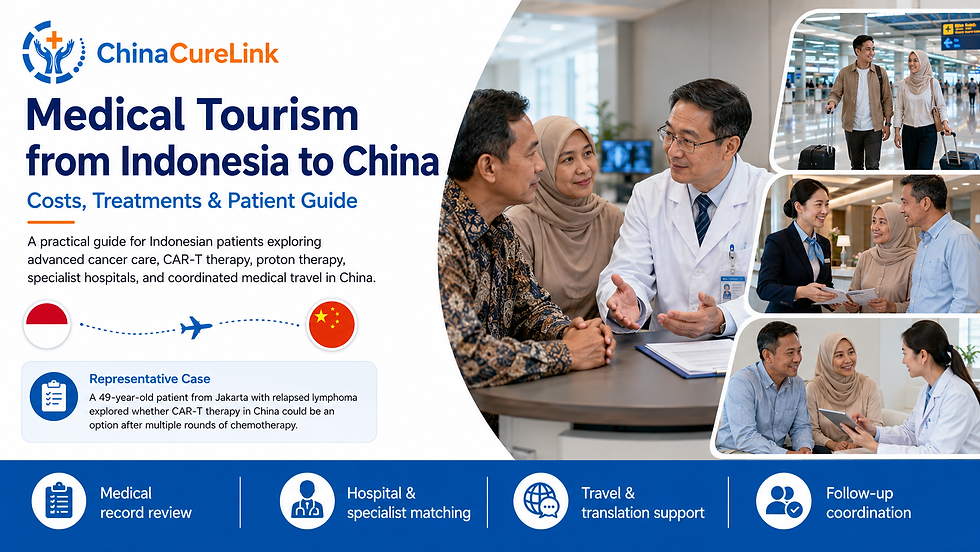
How ChinaCureLink Helps Indonesian Patients
ChinaCureLink helps Indonesian patients access suitable hospitals and specialists in China, especially for advanced oncology and complex medical conditions.
For families in Jakarta, Surabaya, Medan, Bali, Bandung, Batam, Kalimantan, and Makassar, the hardest part is often not deciding to travel. It is knowing which China hospital and which specialist are appropriate.
ChinaCureLink helps with medical record organization, translation, remote case review, hospital matching, appointment coordination, travel planning, and post-treatment follow-up communication.
This is especially useful for patients considering CAR-T therapy, proton therapy, complex cancer surgery, targeted therapy, immunotherapy, or access to innovative treatment pathways in China.
ChinaCureLink is affiliated with Medebound HEALTH, an international healthcare navigation company headquartered in New York with operations across North America and Asia-Pacific. Medebound HEALTH describes its services as helping global patients access expert second opinions, medical navigation, and care coordination.
→ Read Full Guide: Medical Tourism in China 2026 for Southeast Asian Patients
Learn about treatment planning, travel logistics, costs, and patient support services for medical care in China.
What Patients Say About ChinaCureLink & Medebound HEALTH
China CureLink operates under Medebound HEALTH — an internationally recognized healthcare navigation company incorporated in New York, with operations across North America and Asia-Pacific.
Rated 4.6 ⭐⭐⭐⭐⭐ at Trustpilot
Medebound HEALTH's online testimonials. Learn More

Next Steps: How to Get Started
8. Real Patient Story: Kuala Lumpur to Shanghai
A 52-year-old patient from Kuala Lumpur was diagnosed with relapsed lymphoma after several rounds of chemotherapy. His family had already consulted a private hospital in Malaysia and wanted to understand whether CAR-T therapy or another advanced option might be appropriate.
The family collected his PET-CT scans, biopsy report, immunohistochemistry, blood results, discharge summaries, and medication history. Through a coordinated remote review, the case was assessed by a China-based hematology team. The doctors requested additional infection screening and confirmed that the patient might be considered for further evaluation, depending on repeat testing.
Before travel, the family received an estimated treatment range, a likely hospital stay timeline, translation support details, and a list of required documents. They flew from Kuala Lumpur to Shanghai for in-person assessment. After arrival, the patient underwent repeat imaging, blood work, cardiac evaluation, and specialist consultation.
The final recommendation included treatment sequencing, CAR-T eligibility discussion, risks, expected monitoring, and follow-up requirements after returning to Malaysia. The family later shared that the most helpful part was not just access to a hospital, but having each step explained clearly in a language they could understand.

Patient details have been anonymized and adapted to protect privacy.
9. FAQ: Medical Tourism from Malaysia to China
Do Malaysians need a visa for medical travel to China?
For short stays, Malaysian ordinary passport holders can enter China visa-free under the mutual visa exemption arrangement. Each stay is capped at 30 days, with a cumulative limit of 90 days within 180 days. Longer treatment may require additional visa planning.
Is China cheaper than Malaysia for treatment?
Not always. Malaysia is already affordable for many private treatments. China is usually more attractive for advanced oncology, CAR-T, proton or heavy ion therapy, complex second opinions, and specialist access.
Which Chinese cities are best for Malaysian patients?
Common destinations include Shanghai, Beijing, Guangzhou, Shenzhen, Hangzhou, and Hainan, depending on diagnosis and treatment type.
Can I get a remote second opinion before traveling?
Yes. For most complex cases, remote review should happen first so patients avoid unnecessary travel.
10. Conclusion
Medical tourism from Malaysia to China is most valuable for patients who need advanced treatment options, deeper specialist review, or access to China’s fast-growing oncology and medical innovation ecosystem. It is not the right path for every patient, but for selected cases, it can open doors that may not be easily available locally.
For Malaysian families considering treatment in Shanghai, Beijing, Guangzhou, Shenzhen, or Hainan, the smartest first step is a structured medical record review. ChinaCureLink can help assess your case, identify suitable hospital options, and coordinate the next stage of care with clarity and confidence.
About ChinaCurelink
ChinaCurelink helps patients across Southeast Asia — including Indonesia, Malaysia, the Philippines, Vietnam, and Thailand — access the best cancer treatment at China's top hospitals, without the delays, language barriers, and administrative confusion that typically come with seeking care abroad.
We connect patients directly with China's top 5 cancer hospitals, ensuring that from the first case submission through to treatment and follow-up, every step is guided, translated, and coordinated by a team that understands both the medical and cultural needs of Southeast Asian patients.
ChinaCurelink is proudly affiliated with Medebound HEALTH— an international medical concierge company headquartered in New York, specialized in securing premium second opinions from top US hospitals and specialists. With over 10 years of experience and more than 3,000 patients served worldwide, Medebound HEALTH is recognized as one of the leading patient access services across North America and the Asia Pacific, Medebound HEALTH brings the same standard of expert care coordination to every patient we serve.
This article is for informational purposes only and does not constitute medical advice. All treatment decisions should be made in consultation with a qualified oncologist who has reviewed your complete medical history and current diagnostic information.

Comments