Updated: Jul 29
Table of Contents
|
Introduction
Medical tourism from Indonesia to China is becoming an important option for patients from Jakarta, Surabaya, Medan, Bandung, Bali, Batam, Kalimantan, and Makassar who are looking for advanced cancer care, CAR-T therapy, proton therapy, complex surgery, and specialist second opinions.
Indonesian patients have long traveled abroad for healthcare. A 2024 scoping review reported that nearly two million Indonesians traveled overseas for medical treatment in 2022, with many going to Malaysia and Singapore. Common treatment areas included cardiology, orthopedics, cancer care, fertility, neurosurgery, urology, ophthalmology, and cosmetic procedures.
China is now becoming part of that conversation, especially for patients who need advanced oncology treatment, cellular therapy, particle radiation, innovative drugs, or access to large specialist hospitals in Shanghai, Beijing, Guangzhou, Shenzhen, Hangzhou, and Hainan.
Why Medical Tourism from Indonesia to China Is Growing
China offers a different value proposition from traditional Southeast Asian medical destinations. For Indonesian patients, China is not usually chosen for basic checkups or routine minor procedures. It is more often considered for complex disease management, especially when local options feel limited or when a family wants another expert opinion.
China’s major hospitals are large, high-volume centers. Many top hospitals in Shanghai, Beijing, Guangzhou, and Shenzhen manage complex cases across oncology, hematology, neurosurgery, cardiology, orthopedics, and transplant-related specialties. For difficult cancers, rare tumors, relapsed leukemia, lymphoma, multiple myeloma, and advanced solid tumors, this depth of experience can be valuable.
Another reason is access to newer medical technology. China has expanded proton and carbon ion therapy facilities, with PTCOG listing multiple operational particle therapy centers across China as of its May 2026 update.
Hainan is also important. The Boao Lecheng International Medical Tourism Pilot Zone has imported hundreds of innovative medicines and medical devices not yet broadly approved on the Chinese mainland, and it focuses on areas such as cancer treatment, orthopedics, stem cell therapy, dentistry, cardiovascular care, and regenerative medicine.
For Indonesian families, geography also helps. Flights from Jakarta, Surabaya, Bali, and Medan to major Chinese cities are far shorter than travel to Europe or the United States. China may also be attractive for Indonesian Chinese families who speak Mandarin, Hokkien, Cantonese, or other Chinese dialects.
→ Read Full Guide: Medical Tourism in China 2026 for Southeast Asian Patients
Learn about treatment planning, travel logistics, costs, and patient support services for medical care in China.
Cost Comparison: Indonesia vs. China
The cost of medical treatment in China depends heavily on the hospital, city, diagnosis, treatment plan, length of stay, medication choice, and complication risk. China is not always cheaper than Indonesia for routine care, but it may be more cost-effective for certain advanced treatments compared with Western countries.
Published international patient guides report China CAR-T therapy pricing commonly around USD 120,000–170,000 for commercial therapies, while proton and carbon ion therapy guides often place China treatment around USD 30,000–55,000 depending on center and case complexity.
Treatment Type | Indonesia Private Care | China Medical Travel Pathway | Notes |
Routine health screening | Usually more convenient locally | May be similar or higher in major cities | Often best done in Indonesia |
Cancer second opinion | Available in Jakarta and major cities | Strong in high-volume oncology centers | Useful for complex or advanced cancer |
Chemotherapy | Varies by drug and insurance | Varies by drug, brand, and hospital | Medication choice drives cost |
Targeted therapy / immunotherapy | Access may vary | Broader options in selected centers | Requires genomic testing |
CAR-T therapy | Limited access by indication | Approx. USD 120,000–170,000+ | Mainly for selected blood cancers |
Proton / carbon ion therapy | Limited or unavailable locally | Approx. USD 30,000–55,000+ | Case selection is essential |
Complex surgery | Available in major Indonesian cities | Available in major China hospitals | Best for highly specialized cases |
For Indonesian patients, the real question is not simply “Which country is cheaper?” The better question is: Which hospital has the right treatment for this exact diagnosis?
Top Medical Treatments Available in China
Advanced Cancer Treatment in China
Cancer care is one of the biggest reasons Indonesian patients consider medical travel to China. Patients with lung cancer, liver cancer, breast cancer, colorectal cancer, nasopharyngeal cancer, gastric cancer, lymphoma, leukemia, brain tumors, sarcoma, and pediatric cancers may seek China-based oncology opinions.
China hospitals may offer multidisciplinary evaluation, genomic testing, targeted therapy, immunotherapy, interventional oncology, minimally invasive surgery, radiotherapy, proton therapy, heavy ion therapy, and clinical trial screening.
This is especially relevant because Indonesia continues to face cancer care access challenges. An IAEA review noted limitations in access to advanced therapies such as targeted agents and immunotherapies, geographic disparities in cancer surgery, and radiotherapy access gaps in Indonesia.
CAR-T China for Indonesian Patients
CAR-T therapy is mainly used for selected blood cancers, including certain leukemias, lymphomas, and multiple myeloma. China has become one of the world’s most active CAR-T development markets, with both approved products and clinical research programs.
Indonesian patients from Jakarta, Surabaya, Medan, Bali, or Kalimantan considering CAR-T in China usually need a detailed review of pathology, flow cytometry, bone marrow results, PET-CT scans, previous chemotherapy, infection status, heart function, kidney function, liver function, and overall fitness.
CAR-T is not a guaranteed cure. It can involve serious risks such as cytokine release syndrome, neurological toxicity, infection, ICU admission, and relapse. Patients should only consider experienced hospitals with strong hematology and intensive care support.
Proton Therapy and Heavy Ion Therapy China
Proton therapy and carbon ion therapy are forms of particle radiation that may help selected tumors near sensitive organs. They are often considered for brain tumors, skull base tumors, head and neck cancers, pediatric tumors, prostate cancer, recurrent cancers, sarcoma, and some complex solid tumors.
China has several operational particle therapy centers, including facilities in Shanghai, Shandong, Wuhan, Hangzhou, Guangzhou, Shenzhen, Chengdu, and other regions listed by PTCOG.
Not every cancer patient needs proton therapy. A radiation oncologist must review imaging, pathology, prior radiation dose, tumor location, and treatment goals before recommending it.
Orthopedics, Spine, and Neurosurgery
Some Indonesian patients explore China for complex spine surgery, scoliosis, spinal tumors, joint replacement, sports injuries, brain tumors, epilepsy surgery workup, Parkinson’s disease evaluation, or minimally invasive neurosurgery.
Cardiology and Complex Diagnostics
China’s major hospitals also provide advanced cardiac imaging, coronary intervention, arrhythmia care, structural heart procedures, and second opinions for complex cardiovascular disease.
If you're trying to understand which CAR-T product is right for your situation, you can read our comparison of Yescarta, Kymriah, and Carvykti here.
You can read how Chinese hospitals are combining traditional Chinese medicine with standard cancer care here.Integrative Oncology in China: TCM + Standard Cancer Care
Step-by-Step Patient Journey from Indonesia to China
Preparing Medical Records Before Travel
A successful medical tourism journey from Indonesia to China should begin before booking flights. Patients should collect diagnosis reports, pathology reports, imaging files, blood tests, surgery notes, medication lists, discharge summaries, and previous treatment timelines.
For cancer patients, pathology slides, immunohistochemistry, genomic testing, PET-CT, MRI, CT, and tumor marker results are especially important.
Remote Case Review by China Specialists
A China-based specialist or hospital department reviews the medical file and determines whether the patient may benefit from in-person consultation, additional testing, or treatment in China.
This step is important because it helps patients avoid unnecessary travel.
Matching Indonesian Patients with the Right China Hospital
A lymphoma patient from Jakarta may need a hematology center with CAR-T experience. A liver cancer patient from Surabaya may need hepatobiliary surgery, interventional radiology, and oncology. A child with a brain tumor from Bali may need pediatric oncology and proton therapy assessment.
The right hospital depends on the disease, stage, urgency, prior treatment, and patient condition.
Quotation and Treatment Planning
Before traveling, Indonesian patients should request a written estimate that separates consultation, tests, admission, procedure cost, drugs, ICU risk, translation, accommodation, and follow-up.
Visa and Travel Planning
Indonesian nationals became eligible for China’s 240-hour visa-free transit policy starting June 12, 2025, but this is a transit policy requiring valid travel documents and confirmed onward tickets to a third country or region. It allows eligible travelers to stay in designated areas for up to 10 days.
For planned medical treatment in Shanghai, Beijing, Guangzhou, Shenzhen, or Hangzhou, 10 days may not be enough. Patients should plan carefully and confirm visa requirements before departure.
Hainan is different. Indonesian citizens are included in China’s Hainan 30-day visa-free entry policy for purposes including medical treatment, but travel is limited to Hainan Province under that policy.
Hospital Arrival and Follow-Up
After arrival, patients usually complete registration, repeat testing, consultation, treatment confirmation, payment, admission if needed, and discharge planning. After returning to Indonesia, discharge summaries should be translated and shared with local doctors.
Challenges Indonesian Patients May Face
The first challenge is language. Mandarin is the primary hospital language in China. Even when doctors can speak English, registration, billing, pharmacy instructions, nursing communication, and consent forms may still require translation.
The second challenge is hospital selection. A famous hospital is not always the right hospital for a specific disease. Indonesian patients need department-level matching, not just city-level matching.
The third challenge is documentation. Many delays happen because imaging files, pathology reports, or treatment summaries are incomplete.
The fourth challenge is cost uncertainty. Advanced cancer treatment can change quickly if new scans show progression or if complications occur.
The fifth challenge is follow-up. Indonesian patients should ask whether medications can continue in Indonesia, whether blood monitoring can be done in Jakarta or Surabaya, and when follow-up with the China team is needed.
How ChinaCureLink Helps Indonesian Patients
ChinaCureLink helps Indonesian patients access suitable hospitals and specialists in China, especially for advanced oncology and complex medical conditions.
For families in Jakarta, Surabaya, Medan, Bali, Bandung, Batam, Kalimantan, and Makassar, the hardest part is often not deciding to travel. It is knowing which China hospital and which specialist are appropriate.
ChinaCureLink helps with medical record organization, translation, remote case review, hospital matching, appointment coordination, travel planning, and post-treatment follow-up communication.
This is especially useful for patients considering CAR-T therapy, proton therapy, complex cancer surgery, targeted therapy, immunotherapy, or access to innovative treatment pathways in China.
ChinaCureLink is affiliated with Medebound HEALTH, an international healthcare navigation company headquartered in New York with operations across North America and Asia-Pacific. Medebound HEALTH describes its services as helping global patients access expert second opinions, medical navigation, and care coordination.
What Patients Say About ChinaCureLink & Medebound HEALTH
China CureLink operates under Medebound HEALTH — an internationally recognized healthcare navigation company incorporated in New York, with operations across North America and Asia-Pacific.
Rated 4.6 ⭐⭐⭐⭐⭐ at Trustpilot
Medebound HEALTH's online testimonials. Learn More

Next Steps: How to Get Started
Real Patient Story
A 49-year-old patient from Jakarta was diagnosed with relapsed lymphoma after several rounds of chemotherapy. His family had already consulted doctors in Indonesia but wanted to know whether CAR-T therapy in China could be an option.
The family gathered his biopsy report, immunohistochemistry, PET-CT scans, blood tests, chemotherapy records, and discharge summaries. A China-based hematology team reviewed the file remotely and requested additional infection screening and organ function testing.
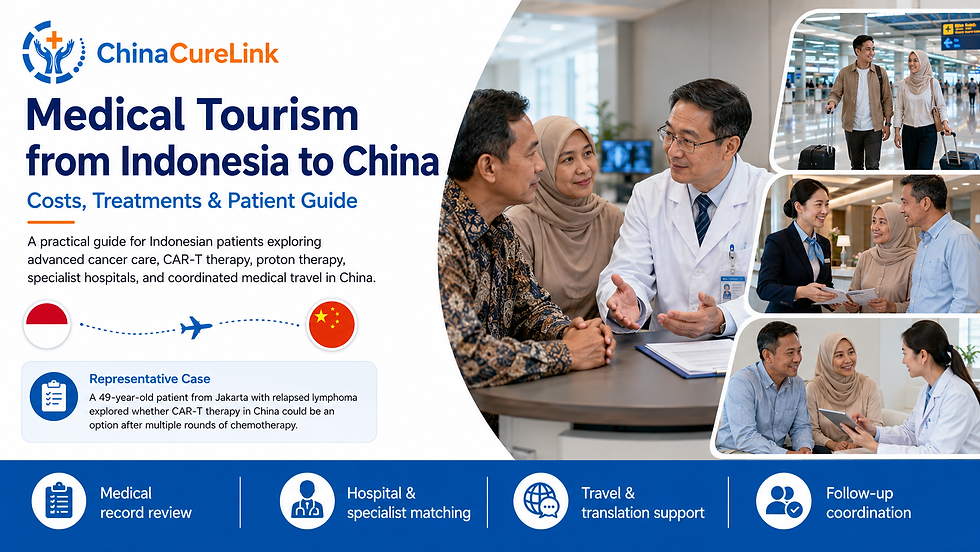
After review, the patient was advised to travel to Shanghai for in-person evaluation. On arrival, he completed repeat imaging, blood tests, cardiac assessment, and specialist consultation. The hospital team then discussed eligibility, risks, expected cost, monitoring requirements, and follow-up after returning to Indonesia.
The family later said the most valuable part was having each step explained clearly before travel, including what was possible, what was uncertain, and what risks needed to be understood.
Patient details have been anonymized and adapted for privacy.
→ Read Full Guide: Top Medical Procedures Available in China
Explore the most sought-after treatments in China, including cancer care, CAR-T therapy, stem cell treatments, IVF, and more.
FAQ: Frequently Asked Questions
Do Indonesians need a visa for medical treatment in China?
For mainland China, Indonesian citizens may qualify for the 240-hour visa-free transit policy only if they meet transit requirements, including onward travel to a third country or region. For planned medical care, patients should confirm visa requirements before travel. Hainan allows eligible Indonesians to enter visa-free for up to 30 days for medical purposes, limited to Hainan Province.
Is China cheaper than Indonesia for treatment?
Not always. Indonesia may be more convenient for routine care. China may be more valuable for advanced oncology, CAR-T therapy, proton therapy, complex surgery, or specialist second opinions.
Which Chinese cities are popular for Indonesian patients?
Common destinations include Shanghai, Beijing, Guangzhou, Shenzhen, Hangzhou, and Hainan, depending on the diagnosis.
Can I get a Chinese hospital opinion before traveling?
Yes. For complex cases, remote medical review should happen before booking flights.
Conclusion
Medical tourism from Indonesia to China can be a valuable pathway for patients seeking advanced cancer treatment, CAR-T China access, proton therapy China options, or specialist care in major China hospitals. For families in Jakarta, Surabaya, Medan, Bali, Bandung, Batam, Kalimantan, and Makassar, the safest first step is a structured medical record review before travel.
ChinaCureLink helps Indonesian patients compare suitable China hospitals, coordinate specialist reviews, and plan medical travel with more clarity and confidence.
About ChinaCurelink
ChinaCurelink helps patients across Southeast Asia — including Indonesia, Malaysia, the Philippines, Vietnam, and Thailand — access the best cancer treatment at China's top hospitals, without the delays, language barriers, and administrative confusion that typically come with seeking care abroad.
We connect patients directly with China's top 5 cancer hospitals, ensuring that from the first case submission through to treatment and follow-up, every step is guided, translated, and coordinated by a team that understands both the medical and cultural needs of Southeast Asian patients.
ChinaCurelink is proudly affiliated with Medebound HEALTH— an international medical concierge company headquartered in New York, specialized in securing premium second opinions from top US hospitals and specialists. With over 10 years of experience and more than 3,000 patients served worldwide, Medebound HEALTH is recognized as one of the leading patient access services across North America and the Asia Pacific, Medebound HEALTH brings the same standard of expert care coordination to every patient we serve.
This article is for informational purposes only and does not constitute medical advice. All treatment decisions should be made in consultation with a qualified oncologist who has reviewed your complete medical history and current diagnostic information.


Comments