Choosing a cancer hospital abroad means looking beyond its reputation: does its expertise match your diagnosis, and can you understand the treatment plan before traveling? Three Guangzhou hospitals worth comparing are Sun Yat-sen University Cancer Center, the Affiliated Cancer Hospital of Guangzhou Medical University, and the First Affiliated Hospital of Sun Yat-sen University.
This guide compares documented oncology services and specialist interests. The order is a practical selection aid, not proof that one hospital delivers better outcomes for every cancer. Your cancer type, stage, previous treatment and overall health should guide the choice.
Key Takeaways |
|
Table of Contents
Why consider Guangzhou for cancer treatment?
Guangzhou offers dedicated cancer hospitals as well as comprehensive university hospitals with oncology services. The useful distinction is which team can assess your particular cancer and explain the next clinical decision. Research activity is a reason to ask informed questions, not a reason to assume that an experimental treatment is suitable.
Immunotherapy evidence from Guangzhou investigators
The phase 3 JUPITER-02 trial, involving Sun Yat-sen University Cancer Center investigators, compared toripalimab plus gemcitabine–cisplatin chemotherapy with chemotherapy plus placebo for recurrent or metastatic nasopharyngeal carcinoma. A separate phase 2 trial at the center tested toripalimab before and after chemoradiotherapy in selected high-risk, locally advanced disease.
Study | Population and finding | Limits and harms |
JUPITER-02, phase 3; JAMA, 2023 | 289 patients; median progression-free survival 21.4 vs 8.2 months in the 2023 publication. At 36 months median survival follow-up, overall-survival hazard ratio 0.63 favored toripalimab. | Severe immune-related events: 9.6% vs 1.4%. Applies to the studied treatment setting; not a cure rate. |
Single-center phase 2; The Lancet Oncology, 2024 | 150 selected high-risk patients; two-year progression-free survival 92% vs 74%; median follow-up 37.8 months. | Severe immune-mediated events: 10% with toripalimab. Further comparative research needed; the publication reported enrollment closed. |
Progression-free survival measures time until cancer worsens or death occurs. These findings cannot be applied to other cancers or compared as a head-to-head test of the two regimens. The US FDA also approved toripalimab for specified nasopharyngeal-cancer indications in 2023, so treatment closer to home may be an alternative. Current availability and individual suitability require confirmation.
What should international patients confirm before traveling?
Confirm clinical suitability, treatment access and continuity of care before booking travel. Ask which pathology reports, scan files, biomarker results and previous treatment summaries the receiving team needs, including translation requirements.
Then confirm the department, campus, international registration pathway and language support. Request a written estimate separating investigations, treatment, admission and exclusions from travel and accommodation. Agree who will manage follow-up, medication supply and possible complications after returning home.
How ChinaCureLink helps you compare options
ChinaCureLink, a Medebound HEALTH company, is an independent medical facilitator and patient advocate. It starts with the medical case: organizing the diagnosis, pathology, biomarkers and previous treatments to identify potentially appropriate pathways and compare up to three relevant hospitals or specialists.
A specialist video opinion before travel can help clarify what is worth investigating. The hospital determines clinical suitability, acceptance and any trial eligibility; coordination does not guarantee treatment access or outcomes.
Three cancer hospitals in Guangzhou to compare
1. Sun Yat-sen University Cancer Center
Established in 1964, Sun Yat-sen University Cancer Center combines cancer care, education, prevention and research. Its clinical departments span breast oncology, colorectal surgery, liver surgery, hematological oncology, pediatric oncology and radiation oncology, providing several entry points for a diagnosis-specific assessment.
Nasopharyngeal cancer is a particularly relevant area to investigate. Its radiation oncology department describes expertise in this disease and techniques including intensity-modulated radiation therapy and image-guided treatment. The center also explicitly describes an International Medical Center serving foreign patients. Confirm the appropriate department, campus and language arrangements before travel.
2. Affiliated Cancer Hospital of Guangzhou Medical University
The Affiliated Cancer Hospital of Guangzhou Medical University is a tertiary specialist cancer hospital with clinical care, cancer prevention and research functions. Its official introduction describes oncology research platforms, a molecular testing center and a biobank supporting clinical and translational research.
Its head and neck surgery and radiotherapy profiles provide concrete reasons to investigate the hospital for relevant diagnoses. A thyroid or other head and neck tumor may need a different specialist assessment from a nasopharyngeal cancer requiring radiation planning. Ask the receiving department to explain which services fit your case, and confirm international registration and interpretation arrangements directly.
3. First Affiliated Hospital of Sun Yat-sen University
The First Affiliated Hospital of Sun Yat-sen University is a comprehensive university hospital with an oncology service. This setting is relevant when a patient needs assessment involving other medical and surgical specialties alongside cancer treatment.
Its oncologists' profiles describe chemotherapy, molecularly targeted treatment and immunotherapy for several solid tumors. Their interests include lung and gastrointestinal cancers, while supportive-care expertise can help inform symptom and nutrition planning. This is a separate institution from Sun Yat-sen University Cancer Center. Confirm the department and campus when sending records or requesting a second opinion.
These profiles describe clinical interests, not appointment availability or a promise that a particular doctor will treat you. Ask the hospital to assign the appropriate specialist for your diagnosis.
An individual CAR-T response reported in GuangZhou
A 2024 case report from Shenzhen University General Hospital described a 72-year-old man with pancreatic cancer that had recurred and spread after surgery and multiple chemotherapy regimens. He entered a clinical trial of claudin18.2-targeted chimeric antigen receptor T-cell (CAR-T) therapy.
Treatment course | Documented individual outcome |
November 21, 2022 | CAR-T infusion following lymphodepleting chemotherapy. |
One month after infusion | Complete response reported. |
Follow-up | Clinical remission lasted eight months; claudin18.2-negative relapse occurred in July 2023. |
Safety | Grade 2 cytokine release syndrome and gastric mucosal injury required treatment. |
This was one patient treated in Shenzhen, not an outcome from the Guangzhou hospitals above. The response was not a cure, and individual results vary. The report does not establish routine availability at these hospitals. Seek a specialist second opinion about diagnosis-specific evidence, risks and current access before traveling.
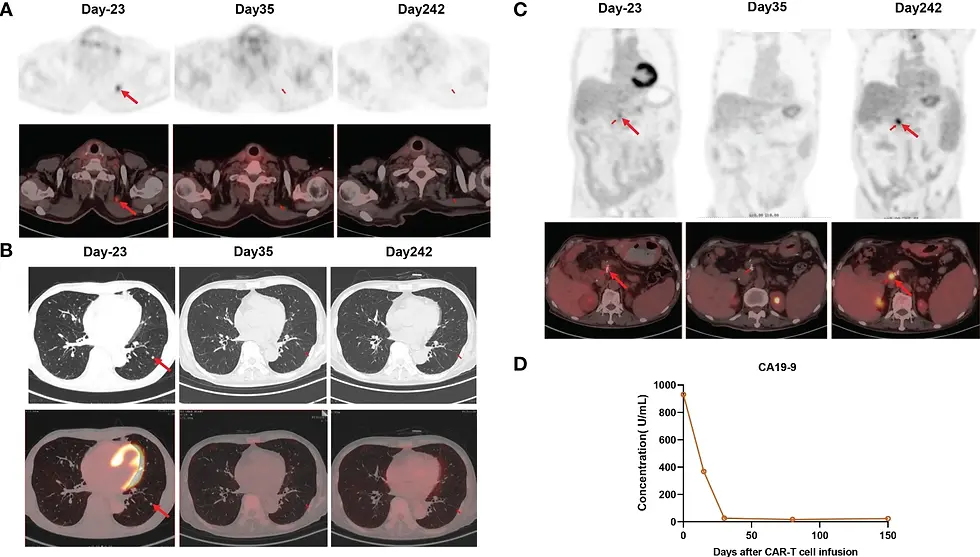
Clinical image: Figure 3 from Zhong et al., Frontiers in Immunology (2024), © the authors, reproduced without alteration under CC BY. The figure documents this individual case; it does not predict another patient’s outcome.
Patient case studies
These patient stories come from ChinaCureLink’s case library. Locations and treatments vary; they are not presented as outcomes from the three Guangzhou hospitals.
Patient testimonials
These reviews describe individual experiences with Medebound Health and its services. They do not establish outcomes or endorse a particular Guangzhou hospital.
How do you choose between these hospitals?
Choose a team that can explain a suitable plan for your particular cancer. Ask whether pathology review is needed, what the treatment goal is, which evidence supports the plan, what alternatives exist and what risks matter most. Confirm whether any proposed option is established care or research, then compare written estimates and follow-up plans.
Practical next steps
Prepare a concise medical summary and ask your current oncologist which questions a second opinion should resolve. Request an assessment from the relevant department, and make travel decisions only after understanding the proposed treatment, alternatives, costs and continuity of care.
Frequently asked questions
Which cancer hospital in Guangzhou should I contact first?
Sun Yat-sen University Cancer Center is a reasonable starting point for broad specialist oncology assessment. The Affiliated Cancer Hospital of Guangzhou Medical University and the First Affiliated Hospital of Sun Yat-sen University also merit consideration for relevant services. The appropriate department depends on your diagnosis, stage and previous treatment.
Do cancer hospitals in Guangzhou accept international patients?
Sun Yat-sen University Cancer Center explicitly describes services for foreign patients through its International Medical Center. For any hospital, confirm acceptance, appointment arrangements, language support and treatment availability before traveling. An English-language website alone does not confirm these services.
How much does cancer treatment in Guangzhou cost?
There is no single price covering all cancer treatment. Request an individualized written estimate specifying investigations, procedures, medicines, admission and exclusions. Keep travel, accommodation, interpretation and follow-up expenses separate when comparing total costs.
Guangzhou offers several different oncology settings. A specialist opinion before travel can help establish which team and treatment pathway deserve further investigation.
Sources and further reading
Sources accessed October 31, 2026. Institutional profile pages are undated unless a publication date is shown.
About ChinaCureLink
ChinaCureLink, a Medebound HEALTH company, is an independent medical facilitator helping international patients explore treatment pathways and coordinate care. It helps organize case information, compare relevant hospitals and seek specialist input before a travel decision.
Disclaimer
This article provides general information, not medical advice. ChinaCureLink coordinates care and is not a hospital. Treatment decisions require assessment by qualified clinicians. Hospital acceptance, physician availability, trial eligibility, treatment access and costs must be confirmed for each case.


