Why Saudi Patients Are Looking at China for Medical Treatment
For many patients in Saudi Arabia, traveling abroad for healthcare is not only about cost. Families often look overseas when they need highly specialized doctors, faster access to complex procedures, advanced cancer therapies, second opinions, or treatment options that may not be widely available locally.
China is becoming a stronger option for Saudi patients because it combines large specialist hospitals, rapidly developing medical technology, advanced diagnostics, and improving international patient services. China has also become easier to visit: Saudi ordinary passport holders are currently eligible for visa-free entry to China for up to 30 days for approved purposes such as tourism, business, family visits, exchanges, and transit through December 31, 2026. Patients should still confirm whether their medical purpose requires a visa or hospital-issued documents before travel.
Why China Is Becoming a Medical Tourism Destination
China’s healthcare system includes major academic hospitals in Beijing, Shanghai, Guangzhou, Shenzhen, Hangzhou, and other large cities. These hospitals often have strong departments in oncology, cardiology, neurology, orthopedics, reproductive medicine, rehabilitation, and minimally invasive surgery.
One of China’s most important medical tourism hubs is Boao Lecheng International Medical Tourism Pilot Zone in Hainan. It was approved by China’s State Council and is designed for international medical tourism, licensed medical services, rehabilitation, cancer prevention and treatment, and access to certain innovative drugs and devices. As of April 2025, Lecheng had imported more than 470 innovative medicines and devices not yet approved on the mainland and had 36 medical institutions in operation.
China is also opening parts of its healthcare sector to more international investment. A 2024–2025 policy allows wholly foreign-owned hospitals in selected regions including Beijing, Tianjin, Shanghai, Guangzhou, Shenzhen, and Hainan, signaling continued internationalization of Chinese healthcare.
Common Treatments Saudi Patients Explore in China
Saudi patients commonly consider China for:
Cancer second opinions, surgery, targeted therapy, immunotherapy, and access to selected oncology medicines
Orthopedic procedures such as joint replacement, spine surgery, sports injury care, and rehabilitation
Cardiology and vascular care
Neurology, stroke rehabilitation, and complex rehabilitation programs
Fertility and reproductive medicine
Advanced diagnostics and full-body health screening
Regenerative medicine and stem cell-related programs, where eligibility and regulatory status must be checked carefully
For any emerging therapy, especially stem cell or cellular treatment, patients should avoid clinics that promise a guaranteed cure. Legitimate hospitals should provide a diagnosis-based plan, explain risks, and clarify whether the treatment is approved, investigational, or available through a pilot-zone pathway.
Visa and Entry Rules for Saudi Patients
Saudi citizens with ordinary passports may enter China visa-free for up to 30 days under the current policy, but the listed visa-free purposes do not clearly include medical treatment. The Chinese Embassy in Saudi Arabia states that those who do not meet the conditions still need to apply for a visa before entering China.
For planned medical treatment, patients should prepare:
Hospital appointment confirmation or invitation letter
Medical records and translated summaries
Return or onward flight details
Hotel or hospital accommodation information
Proof of financial ability if requested
Companion documents if traveling with family members
Saudi-based non-Saudi residents should check requirements based on their passport nationality, not only their Saudi residence status.
Travel from Saudi Arabia to China
Most Saudi patients travel from Riyadh, Jeddah, or Dammam to major Chinese hubs such as Guangzhou, Shanghai, Beijing, Shenzhen, or Haikou/Hainan. Saudia lists flight options to China including Guangzhou, and routes can change by season, so patients should coordinate flight timing around hospital admission dates rather than booking too early.
For patients with serious illness, long flights should be reviewed by the treating doctor. Some patients may need wheelchair assistance, oxygen clearance, medication letters, or a fit-to-fly note.
Cost Comparison Table: Saudi Arabia vs. China for Medical Treatment
Cost Factor | Saudi Arabia | China | What Saudi Patients Should Know |
Public healthcare cost | Saudi citizens can often access government healthcare at little or no direct cost. | International patients usually pay out of pocket. | Saudi public care may be more affordable, but access depends on referral, availability, and treatment type. |
Private hospital care | Private hospitals can be expensive, especially for complex surgery, oncology, fertility, dental care, and rehabilitation. | Private and international hospital costs can be lower than many Gulf private hospitals. | China may be attractive for self-paying patients seeking faster access or broader options. |
Specialist consultation | Private specialist visits may cost more, especially with senior consultants. | Specialist consultations are often more affordable in major hospitals. | Patients should confirm whether the consultation includes report review, translation, and follow-up. |
Diagnostic tests | MRI, CT, PET-CT, pathology, and genetic testing may be costly privately. | Diagnostic testing can be competitively priced, depending on hospital and city. | China can be useful for patients needing fast imaging, lab work, or second-opinion testing. |
Cancer treatment | Public options may be covered, but private or advanced treatments can be costly. | Costs vary widely for surgery, chemotherapy, immunotherapy, radiotherapy, CAR-T, or targeted drugs. | Imported medicines and advanced therapies in China can still be expensive. |
Surgery costs | Private surgery may involve high surgeon, hospital, anaesthesia, and room charges. | Selected surgeries may cost less than private Gulf hospitals. | Robotic surgery, ICU care, and complex procedures increase the final price. |
Rehabilitation | Private rehabilitation can be expensive and may have limited availability. | China often offers structured rehab programs at lower daily rates. | This may benefit stroke, spinal injury, neurological, and post-surgery patients. |
Payment method | Public care may be government-funded; private care may use insurance or self-pay. | Most international patients pay deposits or upfront fees. | Patients should request a written estimate before travel. |
Overall value | Best when treatment is available through the Saudi public system. | Strong option for private-pay patients seeking faster access, specialist review, or advanced hospital care. | The best choice depends on urgency, diagnosis, budget, and treatment goals. |
How to Choose the Right Hospital in China
Choosing a hospital in China should not be based only on online rankings. Saudi patients should look for:
A department that treats the exact diagnosis frequently
A senior specialist with experience in the required procedure or disease
International patient support or interpreter availability
Clear pricing estimate before travel
Written treatment plan and expected hospital stay
Ability to support Muslim dietary needs, privacy preferences, and family companions
Transparent follow-up after returning to Saudi Arabia
For complex cancer, rare disease, pediatric, or surgical cases, it is wise to request a remote medical review before traveling.
Typical Process for Saudi Patients
The journey usually begins with a medical record review. The hospital or facilitator will request diagnosis reports, imaging, pathology, medication history, blood tests, and previous treatment records. After review, the Chinese specialist may recommend either a remote second opinion, in-person evaluation, or a treatment plan.
Once the patient is accepted, the hospital provides an estimated treatment schedule and cost range. Travel documents, visa requirements, translation, accommodation, airport pickup, hospital registration, payment procedures, and interpreter support are then arranged before departure.
After treatment, patients should leave China with a discharge summary, medication plan, follow-up instructions, imaging copies, lab results, and emergency contact details for coordination with doctors back in Saudi Arabia.
Cultural Needs for Saudi Families
Saudi patients often travel with family members, so comfort and privacy matter. Before confirming a hospital, ask about Arabic or English interpretation, private rooms, halal food access, prayer space, female physician availability when needed, and family accommodation near the hospital.
These details can make the difference between a stressful trip and a smooth treatment experience.
Risks to Avoid
Medical tourism can be helpful, but it must be planned carefully. Patients should avoid providers who:
Promise guaranteed results
Refuse to identify the hospital or doctor in advance
Ask for full payment before a medical review
Cannot provide a written diagnosis-based plan
Offer experimental treatments without explaining risks
Do not provide follow-up documentation
Patients with unstable heart disease, severe infection, advanced organ failure, or high travel risk should obtain clearance before flying.
How ChinaCureLink Can Help
ChinaCureLink helps Saudi patients navigate the Chinese healthcare system by matching the case with appropriate hospitals and specialists, coordinating medical record review, arranging translation, supporting travel logistics, and helping families understand treatment options before they commit to travel.
As an affiliate of Medebound HEALTH, a U.S. physician-founded medical concierge company with more than 10 years of experience and over 3,000 patients served across the United States and China, ChinaCureLink provides structured support for patients seeking advanced care in China.
What Patients Say About ChinaCureLink & Medebound HEALTH
China CureLink operates under Medebound HEALTH — an internationally recognized healthcare navigation company incorporated in New York, with operations across North America and Asia-Pacific.
Rated 4.6 ⭐⭐⭐⭐⭐ at Trustpilot
Medebound HEALTH's online testimonials. Learn More

Next Steps: How to Get Started
Real Patient Story: A Saudi Family’s Journey to China
When Ahmed(alias), a 58-year-old patient from Riyadh, was diagnosed with a complex gastrointestinal cancer, his family wanted one thing above all: clarity. After several consultations in Saudi Arabia, they began looking for an international second opinion and were introduced to advanced treatment options in China.
Before traveling, Ahmed’s medical records, imaging, pathology reports, and treatment history were reviewed by a specialist team in China. This helped his family understand whether the journey was medically appropriate before making any commitment. Once accepted, his appointments, hospital admission, interpreter support, and accommodation near the hospital were arranged in advance.
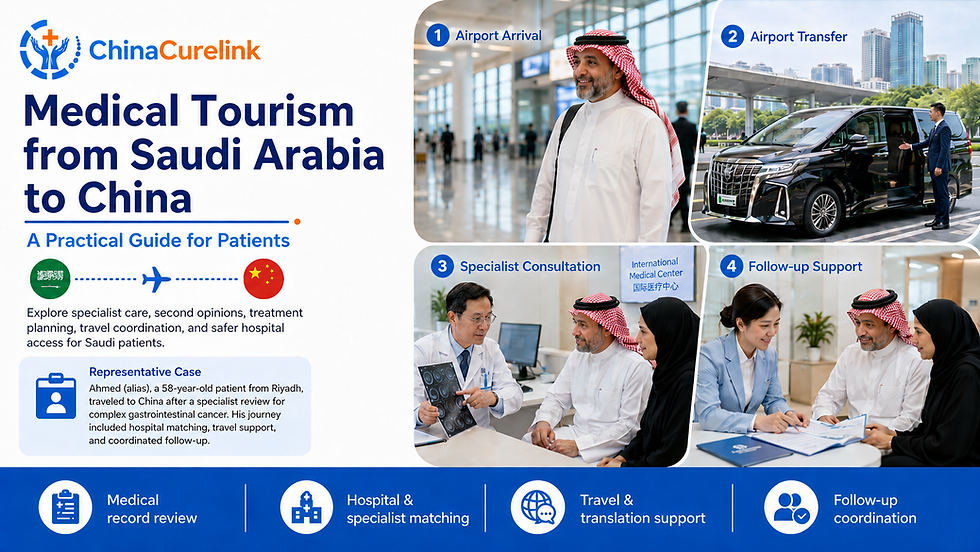
During his stay in China, Ahmed met with a multidisciplinary team that reviewed his condition and recommended a personalized treatment plan. His family appreciated that the doctors explained the goals, risks, and expected timeline clearly. Arabic-friendly coordination and daily support helped reduce the stress of being in a new country.
After treatment, Ahmed returned to Saudi Arabia with a detailed discharge summary, medication instructions, and follow-up recommendations for his local doctors. His family described the experience as “organized, respectful, and reassuring.”
While every patient’s case is different, Ahmed’s story reflects why many Saudi families consider China for complex medical care: access to experienced specialists, advanced hospitals, and coordinated support from the first medical review to the journey home.
Patient name and identifying details changed for privacy.
FAQ: Medical Tourism from Saudi Arabia to China
Is China a good destination for Saudi patients seeking medical treatment?
Yes, China is becoming an increasingly attractive option for Saudi patients who need advanced medical care, specialist consultations, cancer treatment, surgery, rehabilitation, fertility care, or second opinions. Major Chinese hospitals in cities such as Beijing, Shanghai, Guangzhou, Shenzhen, and Hainan offer advanced facilities and experienced specialists for international patients.
What treatments do Saudi patients commonly seek in China?
Saudi patients often travel to China for cancer care, orthopedic surgery, neurology, cardiology, fertility treatment, rehabilitation, stem cell-related consultations, advanced diagnostics, and complex second opinions. The best treatment option depends on the patient’s diagnosis, medical history, and eligibility after specialist review.
Do Saudi citizens need a visa for medical treatment in China?
Saudi citizens may benefit from China’s visa-free entry policy for certain short-term visits, but planned medical treatment may require hospital documents or a proper visa depending on the purpose and length of stay. Patients should confirm entry requirements before booking flights.
How much does medical treatment in China cost for Saudi patients?
The cost depends on the condition, hospital, city, doctor, treatment plan, and length of stay. Basic consultations and diagnostics may be relatively affordable, while cancer treatment, surgery, advanced therapies, and long hospital stays can cost significantly more. Patients should request a written estimate before traveling.
Can Saudi patients get Arabic-speaking support in China?
Some hospitals and medical facilitators can arrange Arabic or English interpreters, airport pickup, appointment coordination, hospital registration, and accommodation support. Saudi families should confirm language support before arrival to avoid communication issues during treatmen
As a Muslim patient, is halal food easy to find in China?
Yes, especially in major cities like Beijing, Shanghai, Guangzhou, Shenzhen, Hangzhou, and Xi’an. Halal restaurants and Muslim-friendly food options are available, but choices may be limited in smaller cities.
ChinaCureLink can help Saudi patients find halal food, nearby mosques, prayer-friendly hotels, and suitable hospital meal options before arrival.
Can ChinaCureLink help Saudi patients arrange treatment in China?
Yes. ChinaCureLink helps Saudi patients with medical record review, hospital and specialist matching, appointment scheduling, translation, travel coordination, and follow-up communication. This support helps families navigate China’s healthcare system more smoothly and confidently.
Final Thoughts
Medical tourism from Saudi Arabia to China is becoming more realistic because of easier travel access, stronger China–Gulf connectivity, and China’s growing role in advanced medical services. For Saudi patients, the key is not simply choosing “China,” but choosing the right hospital, the right specialist, and the right treatment pathway.
A safe medical journey should begin with a professional case review, realistic expectations, transparent costs, and careful planning for travel, language, cultural needs, and follow-up care after returning home.
About ChinaCurelink
ChinaCurelink helps patients across Southeast Asia — including Indonesia, Malaysia, the Philippines, Vietnam, and Thailand — access the best cancer treatment at China's top hospitals, without the delays, language barriers, and administrative confusion that typically come with seeking care abroad.
We connect patients directly with China's top 5 cancer hospitals, ensuring that from the first case submission through to treatment and follow-up, every step is guided, translated, and coordinated by a team that understands both the medical and cultural needs of Southeast Asian patients.
ChinaCurelink is proudly affiliated with Medebound HEALTH— an international medical concierge company headquartered in New York, specialized in securing premium second opinions from top US hospitals and specialists. With over 10 years of experience and more than 3,000 patients served worldwide, Medebound HEALTH is recognized as one of the leading patient access services across North America and the Asia Pacific, Medebound HEALTH brings the same standard of expert care coordination to every patient we serve.
This article is for informational purposes only and does not constitute medical advice. All treatment decisions should be made in consultation with a qualified oncologist who has reviewed your complete medical history and current diagnostic information.


Comments