Updated: Oct 16
Medically reviewed by ChinaCureLink Team
Table of Content
Why This Case Matters
Arif Santoso (alias), a 74-year-old Indonesian man with lung adenocarcinoma, traveled approximately 3,000 kilometers from Jakarta to Guangzhou after surgery was considered too risky locally. At a specialist cancer center in China, a multidisciplinary team developed a staged treatment plan designed to reduce the tumor before directly treating the remaining active tissue.
For international patients facing a similar treatment dilemma, ChinaCureLink can coordinate medical-record review, specialist assessment, treatment planning, travel arrangements and communication with the treating team in China.
Key Takeaways |
|
Patient Background
In July 2025, Arif (alias) developed an intermittent cough accompanied by blood-streaked sputum. A PET/CT scan identified a malignant tumor in the posterior apex of his left lung measuring approximately 4.7 cm, with an SUVmax of 21.4.
He was diagnosed with moderately differentiated adenocarcinoma, classified as cT4N2Mx. The disease involved the left lung and regional lymph nodes.
The tumor presented a particular surgical challenge. It was located close to the interlobar fissure and adjacent to major blood vessels. Because of its location, the size of the lesion and Arif's age, local hospitals considered the operative risk too high and recommended conservative management.
Arif's (alias) family continued looking for another treatment option in China.
The Care Team and Approach
After Arif(alias) arrived in Guangzhou in late September 2025, specialists in oncology, interventional medicine and thoracic surgery reviewed his case as part of a multidisciplinary consultation.
The team determined that directly removing the tumor surgically would be difficult and high-risk. They also considered chemotherapy alone insufficient for local tumor control. The resulting plan was a sequential approach:
Bronchial artery perfusion and embolization — a catheter-based procedure used to identify and treat the arteries supplying the tumor. Chemotherapy was delivered directly into the tumor's blood supply, followed by embolization of the tumor-feeding vessels.
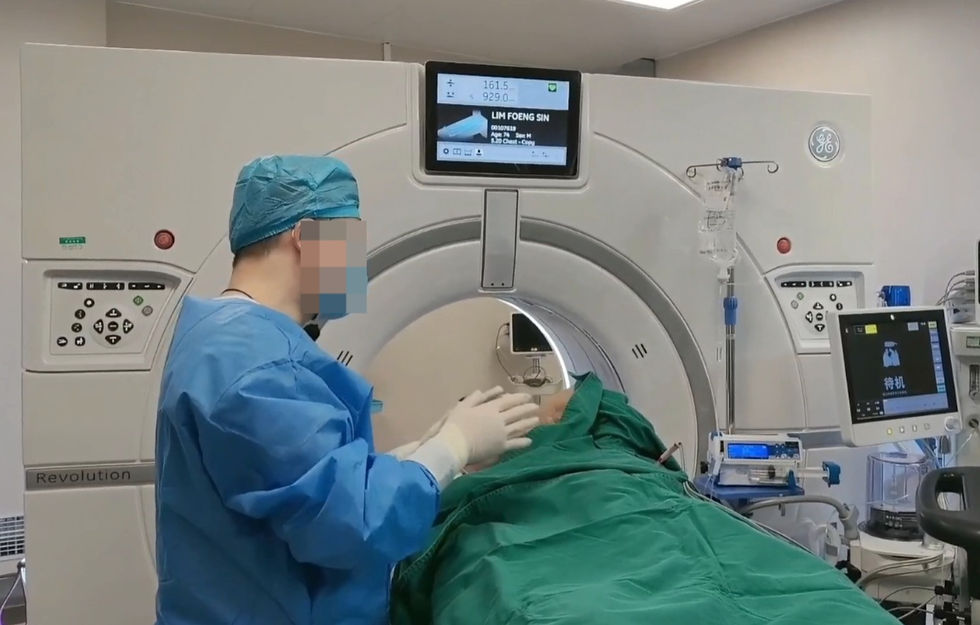
Cryoablation — after the tumor had decreased in size and blood supply, CT-guided cryoablation was used to freeze and destroy the remaining active tumor tissue.
This type of regional arterial treatment has been studied as a locoregional approach for selected lung-cancer patients, although bronchial artery infusion and chemoembolization are not established replacements for standard systemic lung-cancer treatment. Current evidence remains heterogeneous and is largely based on selected clinical series and non-randomized studies.
Cryoablation uses extreme cold delivered through a cryoprobe to destroy targeted abnormal tissue. Image-guided thermal ablation is also recognized as an option for selected lung tumors when the disease can be safely and completely treated with an ablative technique.

Treatment Timeline/ Process
Indonesia — Initial Diagnosis
July 2025: Arif(alias) developed intermittent coughing and blood-streaked sputum.
PET/CT identified a roughly 4.7 cm malignant lesion in the posterior apex of the left lung.
Biopsy established moderately differentiated adenocarcinoma.
The tumor's proximity to the interlobar fissure and major blood vessels made surgery particularly challenging.
Local doctors considered the operative risk too high and recommended conservative treatment.
China — Multidisciplinary Assessment
Late September 2025: Arif arrived in Guangzhou.
Specialists in oncology, interventional medicine and thoracic surgery reviewed his imaging and clinical condition.
The team selected sequential bronchial artery perfusion/embolization followed by cryoablation.
China — Bronchial Artery Treatment
September 29, 2025: The interventional team performed left bronchial artery angiography, perfusion and embolization.
A microcatheter was used to selectively identify the arteries supplying the tumor.
Chemotherapy was delivered through the tumor-feeding artery.
Embolization materials were then used to block the tumor vessels.
One-week imaging showed a substantial reduction in tumor blood supply.
The lesion had decreased from approximately 4.7 cm to 37.5 mm.
China — Cryoablation
October 9, 2025: The remaining lung tumor was treated with CT-guided cryoablation.
The treatment used controlled freeze-thaw cycles to target the remaining active tumor tissue.
The procedure was completed successfully.
Arif was able to get out of bed the following day.
Outcome
The early treatment response was significant.
Following the arterial perfusion and embolization procedure, the tumor's blood supply decreased substantially and the lesion shrank to 37.5 mm. After subsequent cryoablation, Arif experienced significant improvement in his cough and blood-streaked sputum and was mobile the day after the procedure.
The case documents early tumor reduction and symptom improvement. It does not establish complete remission or a cure, and longer-term follow-up is required to determine the durability of the response.
How ChinaCureLink Can Help International Patients to Access This Treatment
For international patients with difficult-to-treat lung tumors, ChinaCureLink can help coordinate the process from medical-record review through treatment planning in China.
The process can include:
Collecting CT, PET/CT, pathology and other medical records for specialist review.
Coordinating a remote assessment with an appropriate multidisciplinary team.
Identifying whether minimally invasive interventional treatment or another approach is appropriate for the patient's tumor location and overall condition.
Coordinating treatment scheduling and communication with the treating hospital.
Arranging practical aspects of international medical travel, including accommodation and local support.
Providing ongoing communication assistance throughout the treatment journey.
Top JCI-acrredited oncology hospital in China provides international-patient services, including multilingual support and assistance with accommodation and transportation.
Patients should be assessed individually because eligibility for bronchial artery treatment, cryoablation or other minimally invasive procedures depends on tumor size, location, blood supply, disease extent, previous treatment and overall health.
Get a Second Opinion Before Fly to China
For suitable cases, ChinaCureLink can then coordinate an online consultation with the specialist to discuss the technical treatment details directly. The purpose is to help the patient understand which treatment option and which specialist center may be most appropriate before making an international treatment decision.
What Patients Say About ChinaCureLink & Medebound HEALTH

China CureLink operates under Medebound HEALTH — an internationally recognized healthcare navigation company incorporated in New York, with operations across North America and Asia-Pacific.
Rated 4.6 ⭐⭐⭐⭐⭐ at Trustpilot
Medebound HEALTH's online testimonials. Learn More
★★★★☆ Sarah Zhang · Canada· Jul 2024 · Verified “The interpreter during the video call was fantastic — super professional and answered all our questions clearly and quickly. The professor was also very patient and gave us detailed and honest guidance on our treatment options.” |
★★★★★ Andrew Goh · Singapore · Aug 2024 · Verified “My first contact with Medebound was over a year ago. Jason has always been responsive, even when I wasn't ready to proceed. When I finally did, the consultation was seamlessly arranged and the specialist was outstanding.” |
★★★★★ Daniel Wong · Singapore · Aug 2024 · Verified “I have dry eye and nothing seemed to be working, even with different medications. I heard about a medication from the U.S. that’s supposed to be really effective, but I didn’t want to try it without talking to a doctor first. MEDEBOUND connected me with a top ophthalmologist in the U.S. and it was so reassuring to get their expert advice.” |
★★★★☆ Pongsakorn · Thailand · Feb 2025 · Verified “Kiki at Medebound is amazing — so professional and helpful! They got my video consultation with an MD Anderson expert set up super fast, within just 5 working days. I am so grateful for their support.” |
Frequently Asked Questions
Could a patient with an inoperable lung tumor be considered for cryoablation in China?
Potentially. Eligibility depends on the tumor's size, location, proximity to critical structures, disease extent and the patient's overall condition. A specialist team needs to review the patient's imaging and medical records before determining whether cryoablation is appropriate.
Can an international patient have their lung-cancer records reviewed before traveling to China?
Yes. Medical records and imaging can be submitted for specialist assessment before travel. This allows the treating team to evaluate the diagnosis, previous treatment and potential treatment options before an international patient makes travel arrangements.
How much does lung-cancer treatment in China cost?
The cost varies according to the diagnosis, treatment plan, number of procedures, hospital stay and additional medical services required. ChinaCureLink can arrange an individualized medical assessment and treatment quotation after reviewing the patient's records.
About ChinaCureLink
ChinaCureLink helps patients across the world access the best cancer treatment at China's top hospitals, without the delays, language barriers, and administrative confusion that typically come with seeking care abroad.
We connect patients directly with China's top cancer hospitals, ensuring that from the first case submission through to treatment and follow-up, every step is guided, translated, and coordinated by a team experienced in cross-border patient care.
ChinaCureLink is proudly affiliated with Medebound HEALTH — founded by US physicians, with over 10 years of experience and more than 3,000 patients served worldwide, Medebound HEALTH is recognized by Forbes and it is one of the most trusted patient cross-border concierge service company across North America and the Asia Pacific.
Disclaimer
This case study is provided for educational and informational purposes only. It describes one patient's treatment experience and does not constitute medical advice or a guarantee of treatment results. Lung-cancer treatment should be determined by a qualified oncologist and multidisciplinary medical team based on the individual patient's diagnosis, imaging, pathology, overall health and treatment history. Patients should discuss potential benefits, risks and alternatives with their treating specialists.


