Updated: Sep 19
Table of Contents
|
For many patients living with Type 1 or Type 2 diabetes, the daily reality of insulin injections, glucose monitoring, medication adjustments, and long-term complication risks can become emotionally and physically exhausting. This has led growing numbers of international families to explore emerging regenerative medicine approaches — including diabetes stem cell treatment in China.
China has emerged as one of the most active research centers globally for stem cell and cell-based diabetes therapies, particularly in pancreatic islet regeneration and insulin-producing beta cell transplantation. While these treatments remain experimental or selectively regulated in many countries, some Chinese hospitals and pilot medical zones now offer access through clinical programs and regulated medical technology pathways.
Average Cost of Diabetes Stem Cell therapy Treatment in China
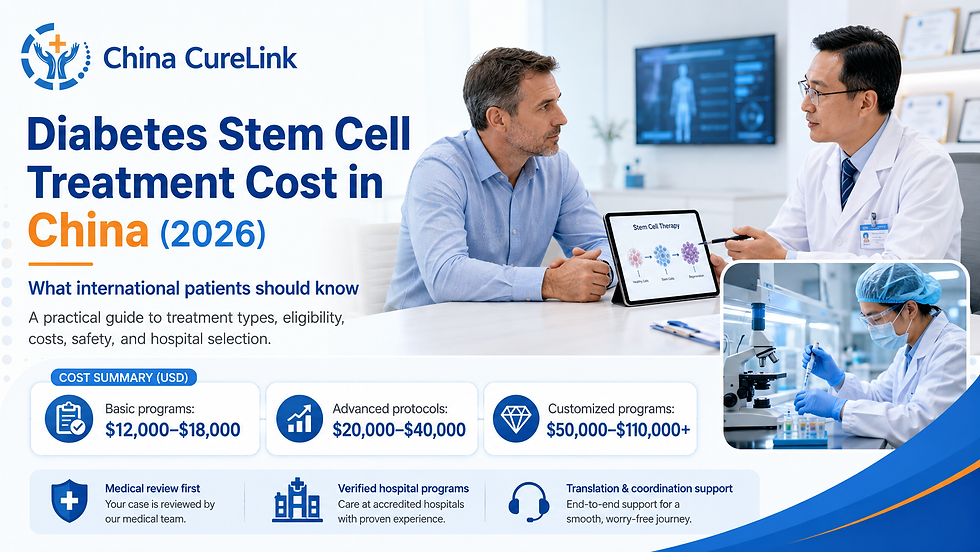
Current international patient pricing for diabetes stem cell therapy in China generally falls within these ranges:
These estimates typically include:
Initial specialist evaluation
Laboratory testing
Stem cell preparation
Cell infusion or transplantation procedures
Hospital monitoring
Short inpatient stay
Follow-up assessments
Several international medical travel sources report that most diabetes stem cell programs for overseas patients currently average approximately $12,000–$18,000 USD depending on complexity and treatment duration.
Why Is Stem Cell Therapy Cheaper in China?
Compared with the United States or parts of Europe, treatment costs in China are often significantly lower due to:
Lower hospital operational costs
Large-scale cell manufacturing infrastructure
Government-supported biotechnology investment
Higher patient treatment volumes
Faster clinical translation environments
Some reports estimate China treatment pricing may be 50–60% lower than comparable U.S.-based cellular therapies.
For comparison, the only FDA-approved islet cell therapy currently available in the U.S., Lantidra, has been reported to cost approximately $300,000 USD before insurance coverage.
What Types of Diabetes Are Being Treated?
Type 1 Diabetes
Most advanced stem cell diabetes research focuses on Type 1 diabetes, where autoimmune destruction damages insulin-producing pancreatic beta cells.
Chinese research groups have explored:
Stem cell-derived islet transplantation
Autologous stem cell approaches
Beta-cell regeneration
Immune-modulating regenerative therapy
Some early-stage clinical reports from China have shown patients achieving temporary insulin independence or significantly reduced insulin requirements after treatment. However, these results are still considered investigational and require larger clinical trials for validation.
→ Read Full Guide: China's Stem Cell Therapy for Type 1 Diabetes – The First Clinical Cure?
Learn about the groundbreaking research, treatment approach, and what it could mean for people with Type 1 diabetes.
Type 2 Diabetes
Stem cell approaches for Type 2 diabetes generally focus on:
Improving insulin sensitivity
Reducing systemic inflammation
Supporting pancreatic function
Delaying progression
A widely discussed 2026 Chinese case report described a patient becoming insulin-free following stem cell-derived pancreatic cell transplantation, though experts caution that broader evidence is still needed before conclusions can be generalized.
→ Read Full Guide: How to Get Stem Cell Therapy for Type 2 Diabetes in China
Learn the step-by-step treatment process, eligibility, and how international patients can access stem cell therapy in China.
What Affects the Cost?
Several factors influence pricing:
1. Type of Stem Cells Used
Costs vary depending on whether therapy uses:
Autologous stem cells (patient-derived)
Donor-derived mesenchymal stem cells
Induced pluripotent stem cells (iPSC)
Stem cell-derived pancreatic islet cells
More sophisticated cellular engineering significantly increases cost.
2. Number of Treatment Cycles
Some patients undergo:
Single infusion protocols
Multiple infusion cycles
Long-term regenerative programs
Additional cycles increase total expenses.
3. Hospital Tier and Location
Top Class 3A hospitals and internationally oriented medical centers generally charge more due to:
Advanced laboratory facilities
International patient departments
Specialized endocrinology teams
Higher safety oversight
4. Length of Stay
Programs can range from:
7-day protocols
2–3 week inpatient monitoring
Extended rehabilitation or follow-up periods
Accommodation and interpreter support also affect final costs.
Is Diabetes Stem Cell Therapy Approved in China?
This is an important question.
Stem cell therapy in China exists within a regulated but evolving framework. Not all therapies are fully approved commercial treatments.
Currently, access may occur through:
Hospital-based clinical research programs
Medical technology pilot zones
Regulated investigational pathways
Government-approved stem cell clinical studies
China’s Hainan Boao Lecheng Pilot Zone has become particularly known for allowing selected advanced medical technologies under regulatory supervision.
At the same time, international patients should understand:
Not all clinics are legitimate
Outcomes vary substantially
Some therapies remain experimental
Long-term durability data is still limited
Immune rejection and procedural risks may exist
No reputable physician should promise a “guaranteed cure.”
→ Read Full Guide: Stem Cell Diabetes Treatment in China – A Step-by-Step Patient Guide
Learn about stem cell therapy types, eligibility, and the complete treatment process for diabetes in China.
Clinical Results: What Does Current Research Show?
Several Chinese and international research groups have reported encouraging findings in early-stage studies.
Reported outcomes include:
Reduced insulin dependence
Improved HbA1c levels
Better glucose stability
Improved C-peptide production
Functional remission in selected patients
In 2026, a Chinese clinical team announced functional remission outcomes in 30 Type 1 diabetes patients using integrative regenerative approaches. However, peer-reviewed long-term validation remains ongoing.
Meanwhile, Nature-covered stem cell transplantation cases involving insulin independence have attracted global attention.
Still, experts emphasize that:
Larger randomized trials are needed
Long-term efficacy remains uncertain
Patient selection is critical
Some patients may not respond
How International Patients Typically Access Treatment
China vs U.S. Stem Cell Diabetes Treatment
China has become one of the most active environments globally for regenerative diabetes research due to substantial investment in biotechnology and translational medicine infrastructure.
FAQ: Frequently Asked Questions
Comparison of Medical Facilitators
ChinaCureLink, as an affiliate of Medebound HEALTH — a New York–based medical concierge company founded by U.S. physicians, recognized by Forbes, with over 10 years of experience and more than 3,000 patients served traveling to the United States and China — brings institutional credibility to every case it handles.
We help patients navigate the complex China care system, identify the most appropriate physicians and hospitals for specific conditions, and coordinate streamlined logistics for international treatment access. By contrast, patients who work with structured medical concierge to China services report a fundamentally different experience
What Patients Say About ChinaCureLink & Medebound HEALTH
China CureLink operates under Medebound HEALTH — an internationally recognized healthcare navigation company incorporated in New York, with operations across North America and Asia-Pacific.
Rated 4.6 ⭐⭐⭐⭐⭐ at Trustpilot
Medebound HEALTH's online testimonials. Learn More
Final Thoughts
Stem cell therapy for diabetes in China represents one of the most closely watched areas in regenerative medicine today. While promising developments continue to emerge, patients should approach treatment decisions with realistic expectations and careful medical guidance.
Some international families begin with a remote expert review before deciding whether travel is necessary. Others may already be exploring advanced regenerative medicine pathways available in China.
Because eligibility, treatment design, and expected outcomes differ substantially between patients, individualized medical evaluation remains essential before considering any stem cell diabetes program.
About ChinaCurelink
ChinaCurelink helps patients across Southeast Asia — including Indonesia, Malaysia, the Philippines, Vietnam, and Thailand — access the best cancer treatment at China's top hospitals, without the delays, language barriers, and administrative confusion that typically come with seeking care abroad.
We connect patients directly with China's top 5 cancer hospitals, ensuring that from the first case submission through to treatment and follow-up, every step is guided, translated, and coordinated by a team that understands both the medical and cultural needs of Southeast Asian patients.
ChinaCurelink is proudly affiliated with Medebound HEALTH— an international medical concierge company headquartered in New York, specialized in securing premium second opinions from top US hospitals and specialists. With over 10 years of experience and more than 3,000 patients served worldwide, Medebound HEALTH is recognized as one of the leading patient access services across North America and the Asia Pacific, Medebound HEALTH brings the same standard of expert care coordination to every patient we serve.


