Updated: Sep 19
Key TakeawaysChina became the first country in the world to approve a CAR-T therapy for a solid tumor: satricabtagene autoleucel (satri-cel), approved June 22, 2026, specifically for CLDN18.2-positive, HER2-negative advanced gastric or gastroesophageal junction cancer that has progressed after at least two prior treatment lines. The article cites two different cost ranges for UAE patients in the same piece — $100,000–$150,000 in one section and $150,000–$200,000 in another — against a U.S. comparison of $373,000–$475,000 for the CAR-T product alone, with total U.S. treatment often reaching $500,000–$700,000 or more. Eligible conditions include diffuse large B-cell lymphoma, other B-cell non-Hodgkin lymphomas, B-cell ALL, multiple myeloma, mantle cell lymphoma, and follicular lymphoma, plus the narrow gastric/GEJ solid-tumor indication — with eligibility determined by pathology, molecular markers, treatment history, disease burden, and organ function, not diagnosis alone. The two major risks are cytokine release syndrome (CRS) and neurotoxicity (ICANS), ranging from fever and low blood pressure to confusion, seizures, or ICU-level care — the article is explicit that these risks exist "in every country," not just in China. ChinaCureLink, affiliated with Medebound HEALTH (New York-headquartered, Forbes-recognized, 10+ years, 3,000+ patients, 4.6★ on Trustpilot), supports UAE patients from medical-record review through treatment and structured handover back to their UAE oncology team. |
For patients in the UAE facing relapsed lymphoma, leukemia, multiple myeloma, or selected advanced cancers, CAR-T therapy can become one of the most important treatment options to discuss with an oncology team.
CAR-T therapy is not a standard chemotherapy treatment. It is a personalized cellular immunotherapy that uses a patient’s own immune cells to recognize and attack cancer cells.
For eligible patients, it can offer an important option after cancer returns or fails to respond to earlier treatments.
The UAE has invested significantly in specialist healthcare, oncology services, and medical innovation. Yet CAR-T treatment remains highly specialized, and patients may still face questions around eligibility, access, treatment pathways, funding, timing, and whether international options should be explored.
China has built one of the world’s most active CAR-T ecosystems, with domestic CAR-T manufacturing, multiple approved products for selected blood cancers, extensive clinical research, and a historic 2026 milestone: the world’s first approved CAR-T therapy for a solid tumor.
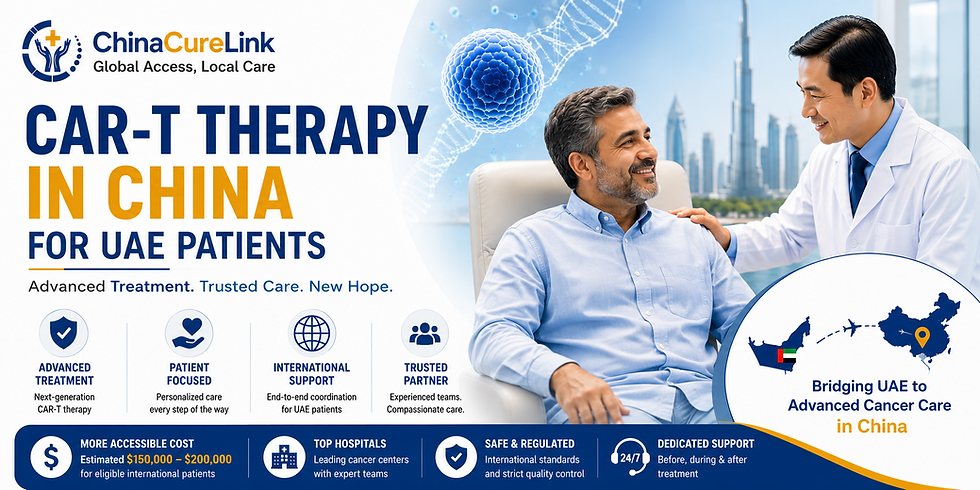
For eligible UAE patients, CAR-T treatment in China may offer practical advantages in cost, access to a rapidly evolving cellular-therapy environment, and international treatment coordination.
ChinaCureLink helps patients and families explore this pathway in a more organized way—from medical-record review and translation to travel coordination, caregiver support, and post-treatment documentation for follow-up in the UAE.
Table of Contents |
Why UAE Patients Are Exploring CAR-T Treatment in China
The UAE has developed advanced cancer-care services and continues to invest in precision medicine, genomics, and specialist treatment programs.
For many patients, receiving treatment in the UAE remains the preferred option. Staying near family, local physicians, and established support systems can be extremely valuable during cancer treatment.
However, some patients with relapsed or refractory disease may need to explore additional pathways.
This may happen when a patient wants an international second opinion, needs to evaluate a different CAR-T pathway, is seeking access to a rapidly growing cell-therapy ecosystem, or is considering a more manageable self-pay option than treatment in the United States.
China is increasingly relevant because it has developed a substantial domestic CAR-T environment.
The country has approved multiple CAR-T products for selected blood cancers, expanded domestic manufacturing capacity, and built one of the world’s most active research environments for next-generation cellular therapies. China’s recent approval of satricabtagene autoleucel, or satri-cel, also made it the first country to approve a CAR-T therapy for a solid tumor.
For UAE patients, China may offer a meaningful combination of cost access, treatment innovation, and international coordination support.
CAR-T in China vs UAE
The UAE and China both have advanced healthcare ambitions, but their CAR-T landscapes are different.
The UAE’s key advantage is proximity. Patients can remain close to their families, communicate in familiar languages, and continue care within their local healthcare system.
China’s potential advantage is its larger domestic CAR-T product ecosystem, extensive research activity, manufacturing capacity, and a treatment pathway that may be more financially accessible for eligible self-pay international patients.
Factor | CAR-T Treatment in UAE | CAR-T Treatment in China |
Patient proximity | Patients can remain close to family and local oncology teams | Requires international travel and a planned stay abroad |
Treatment ecosystem | Advanced oncology sector with evolving cellular-therapy capabilities | Large domestic CAR-T manufacturing, research, and treatment ecosystem |
Product access | Depends on local availability, referral pathway, eligibility, and funding | Multiple domestic CAR-T products approved for selected indications |
International coordination | Usually less relevant for local UAE patients | Requires translation, travel planning, caregiver coordination, and return-home planning |
Self-pay cost | Varies by provider, insurance, and funding pathway | Estimated at $100k-$150k for eligible international patients |
Research activity | Growing precision-oncology environment | Broad CAR-T research activity, including next-generation and dual-target approaches |
Solid-tumor CAR-T milestone | No globally first-approved solid-tumor CAR-T pathway | First country to approve CAR-T for a solid tumor in 2026 |
Follow-up | Easier continuity with local care teams | Requires a structured handover plan after return to the UAE |
This comparison does not mean China is automatically the better choice for every patient.
The right treatment location depends on medical eligibility, urgency, access to local services, funding, travel fitness, caregiver support, and the ability to complete follow-up care safely.
CAR-T Treatment Cost Comparison China vs USA
CAR-T therapy in China costs roughly $100,000–$150,000 in total, compared with $500,000–$700,000 in the United States — about 70–85% less, using NMPA-approved products at leading hospitals.
🇺🇸 United States | 🇨🇳 China | |
Total cost of care | $500,000 – $700,000 | $100,000 – $150,000 |
Typical / median | ~$608,100 | ≈70–85% lower |
What's included | Drug, hospitalization, CRS/ICANS management, supportive care, follow-up | Drug, hospital stay, cell manufacturing, monitoring, follow-up |
Drug price alone | $373,000 – $475,000 (before hospital costs) | Bundled into total |
Approved products | 6 (FDA) | 7 (NMPA) |
Manufacturing time | 3–5 weeks | 24 hrs – 2 weeks at leading centers |
Time on-site | Local | ~6–10 weeks (incl. monitoring) |
Indicative ranges based on 2025–2026 published data and ChinaCureLInk case coordination. Final quotes depend on diagnosis, product, hospital, and length of stay. Not medical or financial advice.
→ Read Full Guide: Nine Years, One Leap – An Italian Patient's CAR-T Journey in China
Read how an Italian woman with multiple myeloma pursued CAR-T therapy in China and her treatment experience.
7 Advantages of CAR-T Therapy in China
1. A More Manageable Self-Pay Treatment Range
For UAE families considering private international treatment, cost can be a major factor.
CAR-T treatment in China is generally estimated at $150,000–$200,000 for eligible international patients. This can be materially lower than the overall cost of commercial CAR-T treatment in the United States, which can reach around $400,000 or more.
Lower cost should not be the only reason to choose a treatment pathway.
However, it can make advanced cellular therapy more financially reachable for patients who do not have full insurance coverage or a government-funded pathway.
2. A Large Domestic CAR-T Manufacturing Ecosystem
CAR-T therapy is a personalized treatment. It requires a patient’s cells to be collected, engineered, expanded, quality-tested, and returned for infusion.
China has invested heavily in domestic biotechnology and cell-therapy manufacturing. This supports a broad ecosystem of CAR-T development and may reduce dependence on imported products.
For patients, a strong manufacturing environment can support access to a wider range of regulated cellular-therapy pathways.
3. Multiple Approved CAR-T Products for Selected Blood Cancers
China has approved multiple CAR-T products for selected blood cancers, including therapies for relapsed or refractory large B-cell lymphoma, multiple myeloma, and B-cell acute lymphoblastic leukemia.
The exact product and treatment pathway must be matched to the patient’s diagnosis, prior therapies, and clinical condition. Not every approved product is appropriate for every patient.
4. A Rapidly Evolving Research Environment
China is one of the major global centers for CAR-T research.
Researchers are studying dual-target CAR-T approaches, next-generation CAR designs, and new strategies intended to address challenges such as antigen escape.
Antigen escape occurs when cancer cells reduce or lose the marker that CAR-T cells were designed to recognize.
Research activity does not guarantee that a therapy is proven or suitable. Patients should ask whether a proposed treatment is approved, investigational, part of a clinical trial, or offered under another regulated pathway.
Still, a large research environment can create additional options for carefully selected patients with difficult-to-treat disease.
5. A Historic Solid-Tumor CAR-T Milestone
On June 22, 2026, China approved satri-cel, the world’s first CAR-T therapy approved for a solid tumor.
The indication is specific: satri-cel is approved for patients with CLDN18.2-positive, HER2-negative unresectable advanced gastric or gastroesophageal junction adenocarcinoma whose disease has progressed after at least two prior lines of treatment.
This does not mean CAR-T is appropriate for all solid tumors or all gastric cancer patients.
It does show that China is contributing important advances in one of the most difficult areas of cellular-therapy research.
6. Remote Medical Review Before Travel
UAE patients should not travel before their medical records have been reviewed.
A structured international pathway begins with pathology reports, imaging, treatment history, laboratory results, discharge summaries, and current physician notes.
A preliminary review can help determine whether CAR-T may be appropriate, what additional testing may be needed, whether the patient is stable enough to travel, and what the likely timeline could be.
7. Dedicated International Patient Coordination
International cancer treatment involves much more than the infusion itself.
Patients may need document translation, visa planning, flights, accommodation, airport transfers, caregiver arrangements, local communication support, and a clear plan for follow-up after returning home.
This is where a medical concierge can make the treatment journey more organized and less stressful for families.
→ Read Full Guide: Is My Child Eligible for CAR-T Therapy?
Learn the key eligibility criteria, required tests, and how to determine if pediatric CAR-T is the right option.
Who May Be Eligible for CAR-T Treatment?
CAR-T therapy may be considered for selected patients with relapsed or refractory cancers.
“Relapsed” means the cancer returned after treatment.
“Refractory” means the cancer did not respond adequately to prior treatment.
Potential candidates may include patients with:
Diffuse large B-cell lymphoma
Selected B-cell non-Hodgkin lymphomas
B-cell acute lymphoblastic leukemia
Multiple myeloma
Mantle cell lymphoma
Follicular lymphoma
Selected advanced gastric or gastroesophageal junction cancers that meet the specific approved biomarker and treatment-history criteria
Eligibility is based on more than diagnosis.
A specialist team may review pathology, molecular markers, previous treatment history, current scans, disease burden, blood counts, organ function, active infections, physical condition, and the need for bridging therapy.
Bridging therapy is treatment used to help control cancer while CAR-T cells are being prepared. It may include chemotherapy, targeted therapy, steroids, radiation, or another strategy selected by the treating team.
→ Read Full Guide: CAR-T Therapy Cost in China for Lymphoma 2026 – International Patient Guide
This detailed guide covers exact pricing, what's included in treatment packages, and real patient timelines.
→ Read Full Guide: CAR-T Therapy in China for Multiple Myeloma 2026 – Complete Patient Guide
Discover myeloma-specific treatment protocols, cost breakdowns, and eligibility requirements.
→ Read Full Guide: Relapsed Refractory Leukemia CAR-T Therapy in China – Complete Overview
Learn about leukemia-specific CAR-T protocols and survival outcome data.
The CAR-T Journey for UAE Patients
Step 1: Prepare Complete Medical Records
Patients should gather pathology reports, biopsy results, imaging reports, treatment summaries, laboratory results, discharge documents, medication lists, and a recent summary from their oncologist.
Complete records allow for a more meaningful preliminary review.
Step 2: Preliminary Case Review
The specialist team reviews whether CAR-T may be clinically appropriate.
The review may identify additional tests, travel concerns, potential contraindications, or alternative treatment options.
Step 3: Travel and Caregiver Planning
If the patient is considered medically suitable to travel, planning can begin.
This may include visa guidance, document translation, flights, accommodation, airport transfers, caregiver arrangements, and communication support.
Travel should only occur after the clinical team confirms it is medically reasonable.
Step 4: On-Site Evaluation and T-Cell Collection
After arrival, the patient receives an in-person evaluation.
If approved to proceed, T cells are collected through leukapheresis, a blood-processing procedure that collects the cells needed for CAR-T manufacturing.
Step 5: Bridging Therapy When Needed
Some patients require disease-control treatment while CAR-T cells are being prepared.
This may be necessary when the cancer is progressing quickly or symptoms need to be controlled.
Step 6: Lymphodepleting Chemotherapy
Before CAR-T infusion, patients usually receive a short course of lymphodepleting chemotherapy.
This prepares the immune environment for the CAR-T cells to expand and function after infusion.
Step 7: CAR-T Infusion and Monitoring
The infusion itself may be brief, but the days afterward are critical.
Patients require close monitoring for fever, low blood pressure, breathing changes, neurological symptoms, infection, and other complications.
Step 8: Recovery and Return-to-UAE Follow-Up
Before returning home, patients need a structured medical handover plan.
This should include discharge records, medication instructions, laboratory-monitoring needs, warning signs, and communication with the patient’s UAE oncology team.
You can find our full guide to navigating cancer hospitals in China here.
CAR-T Safety, Risks, and Monitoring
CAR-T therapy can lead to deep responses in some eligible patients, but it can also cause serious complications.
Two major risks are cytokine release syndrome, known as CRS, and immune effector cell-associated neurotoxicity syndrome, known as ICANS.
CRS occurs when activated immune cells release inflammatory signals into the body. Symptoms can range from fever and fatigue to low blood pressure, breathing problems, organ dysfunction, and intensive-care needs.
ICANS can involve confusion, difficulty speaking, tremors, weakness, seizures, or altered consciousness.
Other possible complications include low blood counts, infection, low immunoglobulin levels, tumor lysis syndrome, fatigue, organ stress, and prolonged hospitalization.
CAR-T should therefore be performed in a specialized setting with experienced oncology, hematology, transfusion, intensive-care, infectious-disease, and emergency-support teams.
China’s 2026 Solid-Tumor CAR-T Milestone
CAR-T therapy has historically been most successful in blood cancers.
Solid tumors are more difficult because CAR-T cells must survive in a challenging tumor environment, reach the cancer, identify the correct target, and avoid damaging healthy tissue.
China’s approval of satri-cel in June 2026 marked a major global milestone.
It became the first CAR-T therapy approved anywhere in the world for a solid-tumor indication. The therapy is intended only for a defined group of patients with CLDN18.2-positive, HER2-negative advanced gastric or gastroesophageal junction adenocarcinoma after at least two prior treatment lines have failed.
For UAE patients with advanced gastric or gastroesophageal junction cancer, molecular testing and specialist review are essential before considering whether this pathway could be relevant.
How ChinaCureLink Supports UAE Patients
Exploring CAR-T treatment abroad can be demanding for patients and families.
A serious cancer diagnosis already brings medical, emotional, and financial pressure. International treatment adds medical records, language differences, travel planning, caregiver needs, and post-treatment coordination.
ChinaCureLink serves as the international medical concierge for UAE patients exploring advanced treatment options in China.
ChinaCureLink does not replace the treating oncologist and does not make clinical decisions.
Its role is to support the coordination around the medical journey.
ChinaCureLink can help with:
Organizing medical records for review
Translating medical documents
Coordinating preliminary case submission
Explaining the likely treatment timeline
Supporting travel and visa preparation
Assisting with airport transfer and accommodation guidance
Helping patients and caregivers communicate during treatment
Preparing medical documentation for follow-up after return to the UAE
For patients considering CAR-T treatment in China, the first step is not booking a flight.
It is obtaining a structured medical review based on complete records, current disease status, and realistic treatment goals.
→ Read Full Guide: CAR-T Treatment in China – A 2026 Guide for International Patients
Learn about eligibility, treatment options, costs, top hospitals, and what international patients can expect throughout the CAR-T journey.
How ChinaCureLink Bridges the Gap for UAE
This is where a purpose-built medical facilitation service becomes essential. ChinaCureLink (powered by Medebound HEALTH ) specialises exclusively in connecting international patients — including Saudi Arabian's — with China's leading oncology institutions.

About ChinaCureLink (Medebound HEALTH): Founded by US physicians, with over 10 years of experience and more than 3,000 patients served worldwide, Medebound HEALTH is recognized by Forbes and it is one of the most trusted patient cross-border concierge service company across North America and the Asia Pacific. Contact us below for free medical record review.
What Patients Say About ChinaCureLink & Medebound HEALTH
China CureLink operates under Medebound HEALTH — an internationally recognized healthcare navigation company incorporated in New York, with operations across North America and Asia-Pacific.
Rated 4.6 ⭐⭐⭐⭐⭐ at Trustpilot
Medebound HEALTH's online testimonials. Learn More
★★★★☆ Sarah Zhang · Canada· Jul 2024 · Verified “The interpreter during the video call was fantastic — super professional and answered all our questions clearly and quickly. The professor was also very patient and gave us detailed and honest guidance on our treatment options.” |
★★★★★ Andrew Goh · Singapore · Aug 2024 · Verified “My first contact with Medebound was over a year ago. Jason has always been responsive, even when I wasn't ready to proceed. When I finally did, the consultation was seamlessly arranged and the specialist was outstanding.” |
★★★★★ Daniel Wong · Singapore · Aug 2024 · Verified “I have dry eye and nothing seemed to be working, even with different medications. I heard about a medication from the U.S. that’s supposed to be really effective, but I didn’t want to try it without talking to a doctor first. MEDEBOUND connected me with a top ophthalmologist in the U.S. and it was so reassuring to get their expert advice.” |
★★★★☆ Pongsakorn · Thailand · Feb 2025 · Verified “Kiki at Medebound is amazing — so professional and helpful! They got my video consultation with an MD Anderson expert set up super fast, within just 5 working days. I am so grateful for their support.” |
Frequently Asked Questions
Can UAE patients receive CAR-T treatment in China?
Yes. Eligible UAE patients may be able to receive CAR-T treatment in China after specialist review confirms that their diagnosis, treatment history, current health status, and travel fitness are appropriate.
Not every patient will qualify.
How much does CAR-T treatment in China cost for UAE patients?
CAR-T treatment in China is generally estimated at $150,000–$200,000 USD for eligible international patients.
This is an estimate, not a guaranteed package price. Final costs can change based on diagnosis, treatment pathway, hospital stay, complications, travel, accommodation, and caregiver requirements.
Is CAR-T treatment available in the UAE?
The UAE continues to expand advanced cancer-care capabilities. Availability of CAR-T may depend on the patient’s diagnosis, referral pathway, funding, program capacity, and eligibility.
Patients should discuss local CAR-T access directly with their oncology team.
Is CAR-T therapy in China safe?
CAR-T has serious risks in every country.
Safety depends on correct patient selection, experienced specialist teams, close inpatient monitoring, rapid management of CRS and ICANS, and a clear follow-up plan after treatment.
Is CAR-T in China better than CAR-T in the UAE?
There is no broad clinical evidence proving that China has universally better CAR-T outcomes than the UAE.
China’s potential advantages include its larger domestic CAR-T ecosystem, active research environment, lower estimated self-pay cost for international patients, and the first approved CAR-T therapy for a solid tumor.
The right option depends on the patient’s individual medical and practical circumstances.
Final Thoughts: Why CAR-T Treatment in China May Be Worth Exploring for UAE Patients
CAR-T therapy is one of the most important advances in modern cancer treatment.
For eligible UAE patients with relapsed or refractory disease, China may offer a valuable pathway to explore.
The advantage is not only the estimated $100k-$150k treatment range.
China also offers a large domestic CAR-T manufacturing ecosystem, active research into next-generation therapies, multiple approved CAR-T products for selected blood cancers, and a historic global breakthrough in solid-tumor CAR-T treatment.
International treatment requires careful planning.
Patients need medical eligibility, transparent costs, travel support, caregiver planning, close monitoring, and a reliable follow-up strategy after returning to the UAE.
For UAE patients and families who want to explore whether CAR-T treatment in China may be appropriate, ChinaCureLink can help coordinate the journey—from medical-record review and translation to travel support, on-the-ground assistance, and post-treatment documentation for follow-up care at home.
About ChinaCureLink
ChinaCureLink helps patients across the world access the best cancer treatment at China's top hospitals, without the delays, language barriers, and administrative confusion that typically come with seeking care abroad.
We connect patients directly with China's top 5 cancer hospitals, ensuring that from the first case submission through to treatment and follow-up, every step is guided, translated, and coordinated by a team that understands both the medical and cultural needs of Southeast Asian patients.
ChinaCureLink is proudly affiliated with Medebound HEALTH— an international medical concierge company headquartered in New York, specialized in securing premium second opinions from top US hospitals and specialists. With over 10 years of experience and more than 3,000 patients served worldwide, Medebound HEALTH is recognized as one of the leading patient access services across North America and the Asia Pacific, Medebound HEALTH brings the same standard of expert care coordination to every patient we serve.

