- Jul 1
- 11 min read
Updated: Jul 30
Key TakeawaysThailand now manufactures CAR-T cells domestically through Genepeutic Bio, its first GMP-certified cell and gene therapy facility, producing cells in roughly 3–4 weeks — faster than the typical 4–8 weeks for imported US products — with structured international programs now running at Bangkok Hospital, Bumrungrad International, Samitivej Children's Hospital, and newer entrants Panacee Hospital and R3 Life Wellness Center. Thailand's facility-reported cost is US$20,000–40,000 for the full package, versus US$400,000–500,000+ commonly quoted in the US — though the article explicitly cautions these are facility estimates, not standardized clinical trial data, and urges getting a written itemized quote before treating any number as final. China's pricing splits two ways relative to Thailand: commercial CAR-T runs US$80,000–170,000 (above Thailand's range), while eligible clinical trial pathways can bring the cost to US$40,000–60,000 — comparable to or below some Thailand estimates, depending on trial eligibility. Thai programs currently cover relapsed/refractory ALL (including pediatric cases), relapsed/refractory large B-cell lymphoma, and select BCMA-targeted myeloma cases requiring prior chemotherapy or transplant failure — the article frames Thailand as strongest for standard, well-covered diagnoses, and China as more relevant for uncommon subtypes, trial-eligible cost reduction, or faster manufacturing when disease is progressing quickly. ChinaCureLink, affiliated with Medebound HEALTH (New York-headquartered, Forbes-recognized, 10+ years, 3,000+ patients, 4.6★ on Trustpilot), offers direct flights from Bangkok to Shanghai, Beijing, or Guangzhou (4–6 hours) and typical S2 medical visa processing of 5–10 business days for patients considering the China pathway. |
Table of Contents |
Introduction
CAR-T (Chimeric Antigen Receptor T-cell) therapy takes a patient's own immune cells and re-engineers them in a lab to hunt down and destroy cancer cells.
Unlike chemotherapy, it's usually a single infusion — a "living drug" that keeps working inside the body long after treatment day.
For patients with relapsed or treatment-resistant blood cancers, this has meant something chemotherapy alone often couldn't: a real shot at complete remission.
It's currently approved for specific blood cancers — leukaemia, lymphoma, and myeloma — not solid tumours, though solid-tumour trials are expanding rapidly worldwide, including in China.
CAR-T Treatment in Thailand: Current Landscape
Thailand has moved from "not an option" to a genuine regional CAR-T destination in a remarkably short window.
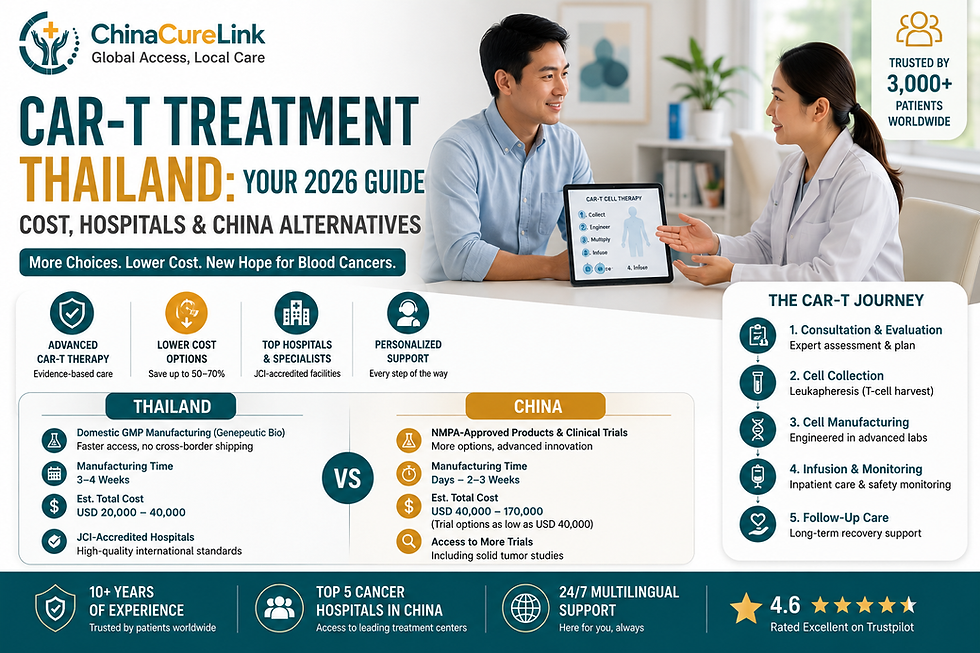
The country's breakthrough came with Genepeutic Bio, Thailand's first GMP-certified cell and gene therapy manufacturing facility, which now produces CAR-T cells domestically in roughly 3–4 weeks — faster than the typical 4–8-week turnaround for US commercial products, and without the cross-border shipping delays that add cost and risk elsewhere.
This local manufacturing capability is the single biggest reason CAR-T treatment in Thailand has become dramatically more accessible over the past two years. Hospitals no longer need to import finished cell products from overseas — they can partner directly with a domestic GMP facility.
Who Is CAR-T Treatment in Thailand For?
Thai hospitals currently offer CAR-T primarily for:
Relapsed or refractory acute lymphoblastic leukaemia (ALL), including paediatric cases
Relapsed or refractory large B-cell lymphoma (LBCL)
Certain multiple myeloma cases using BCMA-targeted CAR-T
Eligibility still depends on prior treatment history — most programmes require that standard chemotherapy or stem cell transplant has already failed.
Yescarta vs. Kymriah vs. Carvykti and other alternatives : Which CAR T Therapy Is Best for Your Cancer?
Top Hospitals Offering CAR-T in Thailand
Several JCI-accredited hospitals now run structured international CAR-T programmes:
Bangkok Hospital — holds ESMO Designated Centre status (2025–2027) and an active collaboration with Oregon Health & Science University (OHSU), a strong signal of academic rigour behind its oncology programme
Bumrungrad International Hospital — ranked Best Specialized Hospital in Asia-Pacific for Oncology (Newsweek, 2023 & 2024), with roughly half of all patients coming from abroad
Samitivej Children's Hospital — a paediatric CAR-T pioneer, having treated multiple children with relapsed leukaemia using domestically manufactured cells, supported by dedicated paediatric hematology-oncology teams
Panacee Hospital (Rama 2) and R3 Life Wellness Center — newer entrants building out GMP-certified cell therapy capabilities
If your child or family member needs paediatric CAR-T specifically, Samitivej's track record with pediatric relapsed leukaemia cases is worth raising directly with your referring oncologist.
How Much Does CAR-T Treatment Cost in Thailand?
This is where Thailand's CAR-T story gets genuinely compelling.
Multiple medical-travel platforms report CAR-T treatment costs in Thailand in the range of US$20,000–40,000 for the full package — a fraction of the US$400,000–500,000+ commonly quoted for commercial CAR-T products in the United States.
That said, a word of caution: these figures are largely drawn from facility-reported estimates, not standardized clinical trial data, and packages vary in what they include (consultation, manufacturing, hospitalisation, monitoring, aftercare). Always request an itemised, written quote from the hospital's international patient office before treating any published number as final.
What's typically included in a Thailand CAR-T package:
Initial consultation and eligibility screening
Leukapheresis (T-cell collection)
Cell manufacturing at a GMP-certified facility
Lymphodepleting chemotherapy
Infusion and inpatient monitoring (often 3–4 weeks)
Basic follow-up care
Plan for a minimum stay of 21+ days in Thailand to cover manufacturing, infusion, and the mandatory post-infusion monitoring window for cytokine release syndrome (CRS) and neurotoxicity.
→ Read Full Guide: CAR-T Therapy Cost in China for Lymphoma 2026 – International Patient Guide
This detailed guide covers exact pricing, what's included in treatment packages, and real patient timelines.
→ Read Full Guide: CAR-T Therapy in China for Multiple Myeloma 2026 – Complete Patient Guide
Discover myeloma-specific treatment protocols, cost breakdowns, and eligibility requirements.
→ Read Full Guide: Relapsed Refractory Leukemia CAR-T Therapy in China – Complete Overview
Learn about leukemia-specific CAR-T protocols and survival outcome data.
Why Thai Patients Are Also Exploring CAR-T Therapy in China
Even with Thailand's relatively lower costs, some Thai families still look to China — and the reasons are worth understanding rather than dismissing.
China's Scale and Speed Advantage
China has built one of the world's largest cell therapy manufacturing sectors, with domestically approved CAR-T products regulated by the National Medical Products Administration (NMPA), and dozens of hospitals now running dedicated international CAR-T programmes.
Key advantages Chinese centres offer:
Manufacturing speed — some Chinese platforms compress production to a matter of days rather than weeks, which can matter significantly for fast-progressing disease
Clinical trial access (IITs) — Investigator-Initiated Trials, regulated by China's National Health Commission, can provide the cell product at little or no cost to eligible international patients, with out-of-pocket expenses limited largely to hospitalisation and diagnostics
Broader disease coverage — a wider range of active solid-tumour CAR-T trials than most Southeast Asian countries currently offer
Depth of experience — leading centres like Peking Union Medical College Hospital and Fudan Cancer Center have treated large volumes of both domestic and international patients
Cost Comparison (2026) Chian vs USA
CAR-T therapy in China costs roughly $100,000–$150,000 in total, compared with $500,000–$700,000 in the United States — about 70–85% less, using NMPA-approved products at leading hospitals.
🇺🇸 United States | 🇨🇳 China | |
Total cost of care | $500,000 – $700,000 | $100,000 – $150,000 |
Typical / median | ~$608,100 | ≈70–85% lower |
What's included | Drug, hospitalization, CRS/ICANS management, supportive care, follow-up | Drug, hospital stay, cell manufacturing, monitoring, follow-up |
Drug price alone | $373,000 – $475,000 (before hospital costs) | Bundled into total |
Approved products | 6 (FDA) | 7 (NMPA) |
Manufacturing time | 3–5 weeks | 24 hrs – 2 weeks at leading centers |
Time on-site | Local | ~6–10 weeks (incl. monitoring) |
Indicative ranges based on 2025–2026 published data and ChinaCureLInk case coordination. Final quotes depend on diagnosis, product, hospital, and length of stay. Not medical or financial advice.
Real Patient Scenario: Weighing the Two Paths
Consider a composite scenario reflecting patterns seen across CAR-T patient communities: a 34-year-old patient in Bangkok with relapsed diffuse large B-cell lymphoma, who has already failed two lines of chemotherapy.
Path A — Thailand: Their oncologist refers them to a Bangkok Hospital CAR-T programme. Domestic manufacturing means a shorter wait than importing cells from overseas, treatment stays close to family, and the total package cost sits within the commonly reported Thailand range.
Path B — China (trial pathway): The same patient's records are reviewed by a Shanghai-based centre running an Investigator-Initiated Trial for their exact lymphoma subtype. If they qualify, the cell product itself may be sponsor-funded — but they'll need an S2 visa, a multi-week stay abroad, and a support person to travel with them.
Neither path is objectively "correct." The right decision depends on trial eligibility, how quickly treatment is needed, and what the family can realistically manage logistically and financially. This is exactly the conversation to have with a haematologist before committing to either country.
Step-by-Step: How to Access CAR-T Treatment (Thailand or China)
Compile complete diagnostic records — bone marrow biopsy results, blood work, imaging, and a full history of prior treatments.
Request eligibility review from your chosen hospital's international patient department. Most respond within 24–72 hours with a preliminary assessment.
Compare quotes in writing — ask for an itemised breakdown covering consultation, manufacturing, hospitalisation, monitoring, and any hidden fees like translation or accommodation.
Arrange travel logistics — for China, this includes an S2 medical visa application once the hospital issues an invitation letter; Thai patients may need this for China but not for domestic treatment.
Undergo apheresis (T-cell collection) — a 2–4 hour outpatient procedure.
Wait through the manufacturing window — sometimes with bridging therapy to control disease progression in the interim.
Receive lymphodepleting chemotherapy, followed by the CAR-T infusion itself.
Complete mandatory post-infusion monitoring — typically 2–4 weeks inpatient or near-hospital, watching for CRS and neurotoxicity.
Plan long-term follow-up — regular blood work and imaging for months after discharge, regardless of which country you were treated in.
Questions to Ask Before You Commit
Before choosing a hospital in either country, get direct answers to:
Has a specialist at this specific centre reviewed my case, or is this a general cost estimate?
What happens if I develop severe CRS or neurotoxicity — is ICU-level care available on-site?
What is the complete, itemised cost — not just the headline figure?
What is the realistic total time I'll need to be away from home and work?
What does long-term follow-up look like once I return home?
If I don't respond to treatment, what are my next options?
These questions protect you from decisions made on hope and marketing copy rather than clinical facts — and any reputable centre will welcome them.
Final Verdict: Which Path Fits Your Situation?
There's no single right answer between CAR-T treatment in Thailand and CAR-T therapy in China — only the answer that fits your diagnosis, timeline, and financial reality.
If you have a standard eligible blood cancer diagnosis, want to stay close to home, and value predictable, English-supported care, Thailand's growing domestic CAR-T infrastructure — anchored by Genepeutic Bio's local manufacturing — is a strong, increasingly well-documented option.
If your cancer subtype isn't well-covered locally, if a clinical trial could substantially reduce your costs, or if disease progression makes China's faster manufacturing timelines clinically important, it's worth having that conversation with your oncologist too.
Whichever direction you're leaning, the most valuable next step is a direct conversation with your treating haematology team about eligibility, timeline, and cost.
→ Read Full Guide: CAR-T Therapy in China 2026 – Complete Treatment Guide, Costs & Top Options
Learn about CAR-T therapy, eligibility, treatment costs, top hospitals, and the patient journey in China.
How ChinaCureLink Bridges the Gap for Thailand Patients
This is where a purpose-built medical facilitation service becomes essential. ChinaCureLink (powered by Medebound HEALTH ) specialises exclusively in connecting international patients — including Thailand's — with China's leading oncology institutions.

About ChinaCureLink (Medebound HEALTH): Founded by US physicians, with over 10 years of experience and more than 3,000 patients served worldwide, Medebound HEALTH is recognized by Forbes and it is one of the most trusted patient cross-border concierge service company across North America and the Asia Pacific. Contact us below for free medical record review.
What Patients Say About ChinaCureLink & Medebound HEALTH
China CureLink operates under Medebound HEALTH — an internationally recognized healthcare navigation company incorporated in New York, with operations across North America and Asia-Pacific.
Rated 4.6 ⭐⭐⭐⭐⭐ at Trustpilot
Medebound HEALTH's online testimonials. Learn More
★★★★☆ Sarah Zhang · Canada· Jul 2024 · Verified “The interpreter during the video call was fantastic — super professional and answered all our questions clearly and quickly. The professor was also very patient and gave us detailed and honest guidance on our treatment options.” |
★★★★★ Andrew Goh · Thailand · Aug 2024 · Verified “My first contact with Medebound was over a year ago. Jason has always been responsive, even when I wasn't ready to proceed. When I finally did, the consultation was seamlessly arranged and the specialist was outstanding.” |
★★★★★ Daniel Wong · Singapore · Aug 2024 · Verified “I have dry eye and nothing seemed to be working, even with different medications. I heard about a medication from the U.S. that’s supposed to be really effective, but I didn’t want to try it without talking to a doctor first. MEDEBOUND connected me with a top ophthalmologist in the U.S. and it was so reassuring to get their expert advice.” |
★★★★☆ Pongsakorn · Thailand · Feb 2025 · Verified “Kiki at Medebound is amazing — so professional and helpful! They got my video consultation with an MD Anderson expert set up super fast, within just 5 working days. I am so grateful for their support.” |
Practical Considerations: Visa, Travel, and What to Bring
Medical Visa for Thailand to China
Thailand citizens are eligible to apply for a Chinese medical (M) visa when travelling for treatment at a recognised Chinese medical institution. Your facilitator will provide an invitation letter from the hospital — a required component of the visa application. Processing typically takes 5–10 business days.
Travel Time and Logistics
Direct flights from Bangkok to Shanghai (PVG), Beijing (PEK), or Guangzhou (CAN) are available, with travel times of approximately 4–6 hours
Accommodation near treatment centres ranges from international hotel chains to serviced apartments — your facilitator can recommend and book appropriate options.
A companion or carer accompanying the patient is strongly recommended, especially during the post-infusion monitoring period.
What to Bring
All available medical records (pathology, imaging, treatment history) in English — ideally certified copies
A complete medication list
Travel insurance documentation (note: standard travel insurance does not cover pre-existing cancer treatment; specialist medical travel insurance is available)
Power adapters (China uses Type A, C, and I plugs — Thailand plugs are compatible with Type I sockets)
Translation apps and a VPN (social media and Google services are restricted in China)
Language Support
ChinaCureLink provides interpreter services throughout your hospital stay. Major oncology hospitals in Shanghai, Beijing, and Hangzhou also have international patient departments with English-speaking staff.
FAQ: Frequently Asked Questions
Is CAR-T therapy available in Thailand?
Yes. Thailand offers CAR-T therapy through hospitals like Bangkok Hospital, Bumrungrad International, and Samitivej Children's Hospital, supported by domestic GMP-certified manufacturing via Genepeutic Bio.
How much does CAR-T treatment cost in Thailand?
Facility-reported estimates put the full package at roughly US$20,000–40,000, though this varies by hospital, cancer type, and what's included — always confirm with a written itemised quote.
Is CAR-T therapy in China cheaper than in Thailand?
It depends on the pathway. China's clinical trial routes can be competitive with or cheaper than Thailand's reported range, but China's commercial CAR-T pricing (roughly $80,000–170,000) typically runs higher than Thailand's facility estimates.
Which CAR-T products are approved in China?
Medical Products Administration (NMPA) has approved multiple domestic and licensed CAR-T products for blood cancers, including CD19-directed and BCMA-targeted therapies. Approval status and indications vary by hospital, so confirm the specific product and indication with the treating centre directly.
How do I know if I qualify for a clinical trial in China instead of paying commercial prices?
Eligibility for Investigator-Initiated Trials (IITs) depends on your specific cancer subtype, prior treatment history, and the trial's inclusion criteria. Submit your full diagnostic records to the hospital's international patient office for a preliminary review — most respond within 24–72 hours.
Is CAR-T therapy in China as safe as in Western countries or Thailand?
Leading Chinese academic centres report remission and safety outcomes comparable to Western data for approved indications. That said, quality and English-language support vary significantly by hospital — verify accreditation, ICU capability, and international patient support directly before committing.
How long will I need to stay in China for treatment?
Plan for several weeks at minimum — covering cell manufacturing (as fast as days at leading centres, but sometimes longer), the infusion itself, and a mandatory post-infusion monitoring period of roughly 2–4 weeks to watch for cytokine release syndrome and neurotoxicity. Some patients stay a few months depending on recovery and trial protocol.
About ChinaCureLink
ChinaCureLink helps patients across the world access the best cancer treatment at China's top hospitals, without the delays, language barriers, and administrative confusion that typically come with seeking care abroad.
We connect patients directly with China's top 5 cancer hospitals, ensuring that from the first case submission through to treatment and follow-up, every step is guided, translated, and coordinated by a team that understands both the medical and cultural needs of Southeast Asian patients.
ChinaCureLink is proudly affiliated with Medebound HEALTH— an international medical concierge company headquartered in New York, specialized in securing premium second opinions from top US hospitals and specialists. With over 10 years of experience and more than 3,000 patients served worldwide, Medebound HEALTH is recognized as one of the leading patient access services across North America and the Asia Pacific, Medebound HEALTH brings the same standard of expert care coordination to every patient we serve.


Comments