Updated: Oct 15
Medically reviewed by ChinaCureLink Team
Table of Content
Why This Case Matters
Sergei(alias), a 34-year-old physics professor from Russia with recurrent small cell carcinoma of the maxillary sinus, traveled to China after chemotherapy and immunotherapy stopped controlling his cancer. His case shows how BNCT can provide another treatment pathway for selected patients with difficult-to-treat head and neck cancers. For international patients facing recurrent or treatment-resistant disease, ChinaCureLink can help arrange specialist case review and coordinate access to appropriate hospitals and innovative treatments in China.
Key Takeaways |
|
Patient Background
Sergei(alias) was 34, physically active, and had rarely needed hospital care before his cancer diagnosis.
In November 2025, a biopsy confirmed small cell carcinoma of the maxillary sinus, a rare and aggressive malignancy. Within two months, the disease had spread from the sinus to lymph nodes in his neck and above the collarbone.
Sergei(alias) underwent seven cycles of chemotherapy and immunotherapy. The first two cycles produced a strong symptomatic response. His facial swelling, tumor-related pain, and visible tumor all disappeared.
The response did not last. His cancer developed resistance to treatment, while the accumulated side effects became increasingly difficult. His vision deteriorated, and he began losing teeth.
By April 2026, imaging showed that the cancer had returned in the left maxillary sinus and spread to the right cervical lymph nodes. Further conventional chemotherapy or radiation offered limited prospects for controlling the disease while adding further treatment burden.
With few remaining options, Sergei and his family began looking for another approach.
The Care Team and Approach
Sergei(alias) learned about Boron Neutron Capture Therapy through an online cancer support group. His case was subsequently reviewed remotely by a specialist team at a dedicated BNCT hospital within the Boao Lecheng International Medical Tourism Pilot Zone in Hainan.
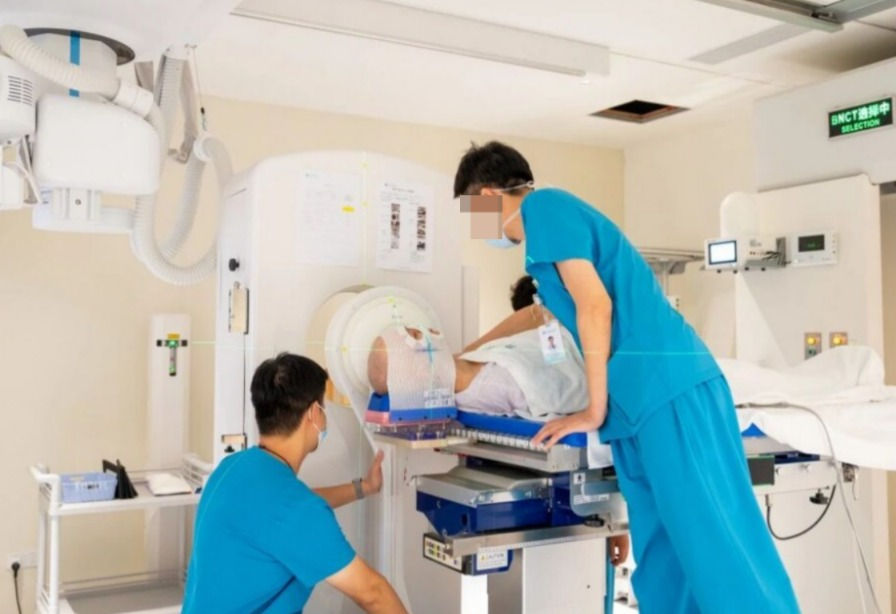
BNCT works through a two-stage process. First, a boron-containing drug is administered intravenously. The boron compound accumulates preferentially in tumor cells. The treatment area is then exposed to an epithermal neutron beam.
When boron-10 captures a neutron, it undergoes a nuclear reaction that produces high-energy particles capable of damaging the cancer cell from within. Because these particles travel only a very short distance, the approach is designed to concentrate the radiation effect at the cellular level.
For Sergei(alias), this provided a treatment approach fundamentally different from conventional external-beam radiation. His treatment plan was individualized following remote review and eligibility assessment by the medical team, led by a pseudonymized hospital director, Dr. Alexei Morozov (alias).
BNCT can be particularly relevant to selected head and neck cancers because it can deliver the irradiation in a single treatment session. The dedicated treatment center in Hainan began clinical operations in 2026, making BNCT available to eligible patients within China's Boao Lecheng medical-access framework. Current external reporting confirms that the center began its first clinical BNCT treatments in March 2026.
Treatment Timeline/ Process
In Russia
November 2025: Biopsy confirmed small cell carcinoma of the maxillary sinus.
Late 2025–early 2026: Cancer spread to cervical and supraclavicular lymph nodes.
Seven treatment cycles: Received chemotherapy and immunotherapy.
Initial response: Facial swelling, pain, and visible tumor symptoms disappeared after the first two cycles.
Treatment resistance: The cancer subsequently progressed despite therapy, while treatment-related side effects accumulated.
April 2026: Imaging showed recurrence in the left maxillary sinus and metastasis to the right cervical lymph nodes.
In China
May 17, 2026: Traveled to Hainan, China, for evaluation and treatment.
Remote case review: The specialist team reviewed Sergei's medical records and confirmed his eligibility for BNCT.
May 20, 2026: Received BNCT, including intravenous boron infusion, positioning simulation, and neutron irradiation.
Treatment duration: The procedure was completed in approximately 30 minutes, without an incision or general anesthesia.
After treatment: Sergei experienced no significant adverse reactions and remained in good spirits.
Recovery and Follow-Up
Two days after treatment: Sergei was discharged.
Before returning to Russia: He spent time in Boao and anticipated returning for further medical care and monitoring.
Ongoing follow-up: His longer-term tumor response remained under observation, with further systemic treatment and additional BNCT considered as part of the treating team's ongoing plan.
Outcome
Sergei(alias) tolerated the BNCT procedure without significant immediate adverse reactions. The day after treatment, he reported that his energy and mood were good and that he felt physically better than before treatment.
At the time of the case report, however, his longer-term tumor response had not yet been established. Follow-up was required to determine how the recurrent maxillary sinus cancer and cervical lymph-node disease responded to treatment.
His treating team also planned continued monitoring and indicated that further BNCT for the cervical recurrence, combined with systemic therapy, could be considered depending on his subsequent clinical course.
How ChinaCureLink Can Help International Patients to Access This Treatment
Sergei's(alias) journey illustrates the type of international treatment pathway that can be difficult to arrange independently: identifying an appropriate innovative therapy, determining whether a specific cancer is suitable, obtaining specialist review, and coordinating treatment in China.
ChinaCureLink can help international patients with advanced or recurrent cancer submit their medical records for specialist review, identify appropriate treatment options, coordinate hospital access, and manage the practical arrangements involved in traveling to China for treatment.
For patients considering BNCT, eligibility depends on the cancer type, location, previous treatment, current disease status, imaging, and the treating team's assessment. A specialist review is therefore the starting point rather than assuming that BNCT is appropriate for every patient with head and neck cancer.
Get a Second Opinion Before Fly to China
For suitable cases, ChinaCureLink can then coordinate an online consultation with the specialist to discuss the technical treatment details directly. The purpose is to help the patient understand which treatment option and which specialist center may be most appropriate before making an international treatment decision.
What Patients Say About ChinaCureLink & Medebound HEALTH

China CureLink operates under Medebound HEALTH — an internationally recognized healthcare navigation company incorporated in New York, with operations across North America and Asia-Pacific.
Rated 4.6 ⭐⭐⭐⭐⭐ at Trustpilot
Medebound HEALTH's online testimonials. Learn More
★★★★☆ Sarah Zhang · Canada· Jul 2024 · Verified “The interpreter during the video call was fantastic — super professional and answered all our questions clearly and quickly. The professor was also very patient and gave us detailed and honest guidance on our treatment options.” |
★★★★★ Andrew Goh · Singapore · Aug 2024 · Verified “My first contact with Medebound was over a year ago. Jason has always been responsive, even when I wasn't ready to proceed. When I finally did, the consultation was seamlessly arranged and the specialist was outstanding.” |
★★★★★ Daniel Wong · Singapore · Aug 2024 · Verified “I have dry eye and nothing seemed to be working, even with different medications. I heard about a medication from the U.S. that’s supposed to be really effective, but I didn’t want to try it without talking to a doctor first. MEDEBOUND connected me with a top ophthalmologist in the U.S. and it was so reassuring to get their expert advice.” |
★★★★☆ Pongsakorn · Thailand · Feb 2025 · Verified “Kiki at Medebound is amazing — so professional and helpful! They got my video consultation with an MD Anderson expert set up super fast, within just 5 working days. I am so grateful for their support.” |
Frequently Asked Questions
Could BNCT be an option after chemotherapy and immunotherapy stop working?
BNCT may be considered for selected patients with recurrent or treatment-resistant head and neck cancers. Eligibility depends on the tumor's location, disease extent, previous treatments, imaging, and the specialist team's assessment.
How long does BNCT treatment take in China?
The BNCT procedure itself can be completed in a single irradiation session. In Sergei's case, the treatment process involving boron infusion, positioning simulation, and neutron irradiation took approximately 30 minutes. The total hospital stay depends on the patient's individual evaluation, preparation, treatment, and follow-up requirements.
How can a Russian or other international patient apply for BNCT treatment in China?
The process begins with a medical case review. Patients typically need to provide their pathology, imaging, treatment history, and current clinical information so the treating team can determine whether BNCT is appropriate. ChinaCureLink can coordinate the medical review and practical arrangements for eligible international patients.
About ChinaCureLink
ChinaCureLink helps patients across the world access the best cancer treatment at China's top hospitals, without the delays, language barriers, and administrative confusion that typically come with seeking care abroad.
We connect patients directly with China's top cancer hospitals, ensuring that from the first case submission through to treatment and follow-up, every step is guided, translated, and coordinated by a team experienced in cross-border patient care.
ChinaCureLink is proudly affiliated with Medebound HEALTH — founded by US physicians, with over 10 years of experience and more than 3,000 patients served worldwide, Medebound HEALTH is recognized by Forbes and it is one of the most trusted patient cross-border concierge service company across North America and the Asia Pacific.
Disclaimer
This account reflects one patient's individual experience, which will vary by case, diagnosis stage, and other clinical factors. ChinaCureLink facilitates access to hospitals and treatment coordination — we do not provide medical care ourselves, and this content is not medical advice. Patients and families should consult a qualified head-and-neck oncologist before making treatment decisions.


