Updated: Sep 19
Introduction
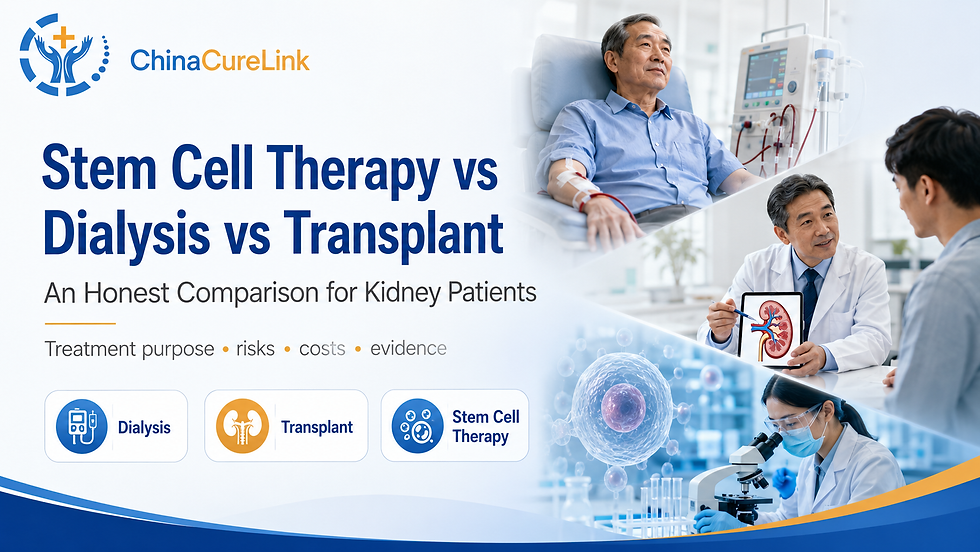
Patients with advanced kidney disease often compare stem cell therapy vs dialysis vs transplant because they want to understand every possible option before making a life-changing decision.
This comparison is understandable. Dialysis can keep patients alive but may feel physically and emotionally demanding. Transplant can offer better long-term quality of life for selected patients but depends on donor availability and eligibility. Stem cell therapy is being explored as an emerging option, but it is not yet a standard cure for kidney failure.
These options are not equal substitutes. They have different purposes, risks, timelines, costs, and evidence levels.
This article gives an honest comparison so patients can understand where each option fits.
Dialysis is a standard life-sustaining treatment for kidney failure. Kidney transplant can offer better long-term quality of life for suitable patients but requires a donor, surgery, lifelong medication, and monitoring.
Stem cell therapy is emerging and investigational for kidney disease. It may be considered by selected patients after medical review, but it should not replace dialysis or transplant evaluation when those are medically necessary.
Simple Comparison Table
Option | Main Purpose | Evidence Level | Main Limitation |
Dialysis | Removes waste and fluid when kidneys fail | Standard care | Ongoing sessions and lifestyle burden |
Transplant | Replaces failed kidney with donor kidney | Standard care | Donor wait, surgery, rejection risk |
Stem cell therapy | Investigational support for repair pathways | Emerging | Not guaranteed, evidence still developing |
Related Guides
Real Patient Journeys: What to Expect Treating Kidney Failure in China
This guide explains what international patients may experience when exploring kidney treatment in China.→ https://www.chinacurelink.com/post/blog-real-kidney-failure-patient-journey-china-case-study
The China CureLink Process: From Case Review to Recovery, Step by Step
This guide explains how case review, hospital matching, travel planning, and follow-up coordination may work.→ https://www.chinacurelink.com/post/blog-chinacurelink-process-medical-treatment-in-china
Why China for Stem Cell Therapy? Regulations, Cost, and Expertise
This article explains why some kidney patients compare China for stem cell therapy.→ https://www.chinacurelink.com/post/blog-why-china-for-stem-cell-therapy-kidney-disease
Are You a Candidate for Stem Cell Kidney Treatment? Key Factors Explained
This guide explains eligibility factors for stem cell kidney treatment review.→ https://www.chinacurelink.com/post/blog-candidate-for-stem-cell-kidney-treatment
What the Research Really Shows About Stem Cells and Kidney Repair
This article reviews what is known and what remains uncertain about stem cells and kidney repair.→ https://www.chinacurelink.com/post/blog-stem-cell-research-kidney-repair
Dialysis: What It Does
Dialysis helps remove waste, extra fluid, and toxins when the kidneys can no longer do enough on their own.
There are two main types: hemodialysis and peritoneal dialysis. Hemodialysis usually involves a machine filtering the blood through a vascular access. Peritoneal dialysis uses the lining of the abdomen to help filter fluid and waste.
Dialysis can be life-sustaining. However, it can affect time, energy, work, diet, travel, and daily routine.
Dialysis does not cure kidney failure. It manages the effects of kidney failure.
Dialysis: Pros and Limits
The main benefit of dialysis is that it can keep patients alive when kidney function is too low.
It can reduce dangerous toxin buildup, fluid overload, and electrolyte problems.
The limits are also important. Dialysis requires ongoing treatment. Some patients feel tired after sessions. Others struggle with access problems, infection risk, low blood pressure, cramps, diet restrictions, or reduced quality of life.
Still, when dialysis is medically necessary, it should not be stopped without nephrologist guidance.
Kidney Transplant: What It Offers
A kidney transplant replaces failed kidney function with a donor kidney.
For many suitable patients, transplant may offer better quality of life than long-term dialysis. Patients may have more flexibility, fewer dialysis-related restrictions, and improved long-term outcomes.
However, transplant is not simple. Patients must qualify medically. They need a donor or waitlist access. They must undergo surgery and take lifelong immune-suppressing medication.
There is also a risk of rejection, infection, medication side effects, and transplant failure.
Transplant: Pros and Limits
The major advantage of transplant is that it can provide a more complete replacement of kidney function than dialysis.
But not every patient qualifies. Patients with severe heart disease, active infection, recent cancer, severe frailty, or other medical risks may not be suitable.
Some patients also wait years for a donor.
Even after transplant, close follow-up is required for life.
Stem Cell Therapy: Where It Fits
Stem cell therapy for kidney disease is different from dialysis and transplant.
It does not filter the blood like dialysis. It does not replace the kidney like transplant. Instead, it is being studied for possible effects on inflammation, immune response, fibrosis, and repair signaling.
Some patients explore it because they want to support remaining kidney function, slow decline, or investigate options beyond standard care.
However, it remains emerging. It should not be described as a proven cure for kidney failure.
Cost Comparison
Costs vary widely by country, hospital system, insurance coverage, treatment type, and the patient’s medical condition. For kidney failure patients, the total cost is not only the procedure or therapy itself. It may also include testing, hospitalization, medications, dialysis support, travel, accommodation, follow-up, and emergency planning.
Stem Cell Therapy vs. Dialysis vs. Transplant Cost Comparison
Cost Area | Dialysis | Kidney Transplant | Stem Cell Therapy |
Main cost type | Ongoing treatment cost | Major one-time surgery cost plus lifelong medication | Treatment course cost plus testing and follow-up |
Payment pattern | Repeated weekly or monthly expenses | High upfront cost, then ongoing monitoring and medication | Usually paid per treatment course or package |
Hospital stay | Usually outpatient, unless complications occur | Requires hospital admission and recovery time | Varies by protocol; may require short hospital stay or monitoring period |
Medication cost | May include anemia drugs, blood pressure medicine, phosphate binders, and other CKD medications | Lifelong anti-rejection medication is usually required | Existing kidney medications usually continue unless doctors advise changes |
Testing cost | Ongoing blood tests, dialysis monitoring, access checks | Pre-transplant testing, surgery workup, post-transplant labs | Pre-treatment labs, kidney function tests, infection screening, follow-up labs |
Long-term cost | Can be high over many years because treatment is continuous | Can be high due to lifelong follow-up and medication | Depends on number of courses, monitoring, and response |
Insurance coverage | May be covered in some countries, but private dialysis can be expensive | May be covered or partly covered depending on system and eligibility | Often self-paid, especially in medical tourism settings |
Travel cost | Usually local unless patient travels for dialysis access | Travel may be needed if transplant center is far away | Travel, accommodation, interpreter, and companion costs may apply |
Main financial risk | Long-term repeated expense | Surgery, complications, rejection, and lifelong medication | Uncertain benefit, possible need for repeat course, and out-of-pocket cost |
Best cost question to ask | “What will this cost every month or year?” | “What are the surgery, medication, and lifelong follow-up costs?” | “What is included in the written package, and what could cost extra?” |
Dialysis may be covered by insurance or national healthcare in some countries, but private dialysis can become expensive over time. Kidney transplant may offer better quality of life for suitable patients, but it includes surgery, hospitalization, donor-related evaluation, lifelong medication, and long-term monitoring.
Stem cell therapy costs vary by country, hospital, protocol, testing, number of treatment sessions, and follow-up. In medical tourism settings, patients should request a written estimate before travel.
The cheapest option is not always the safest or best option. For kidney failure, medical supervision, infection screening, emergency support, dialysis planning, and long-term follow-up matter more than headline pricing.
Quality of Life Comparison
Dialysis can be physically demanding but life-sustaining. Transplant may improve quality of life for suitable patients, but it requires lifelong medication and monitoring.
Stem cell therapy may appeal to patients seeking less invasive options, but outcomes are uncertain and may vary.
Quality of life depends on the patient’s overall health, symptoms, treatment access, family support, and medical stability.
Which Option Is Best?
There is no single best option for everyone.
The best pathway depends on CKD stage, disease cause, symptoms, dialysis status, age, heart health, transplant eligibility, infection risk, financial situation, and patient goals.
For some patients, dialysis is necessary. For others, transplant evaluation is appropriate. For selected patients, stem cell therapy may be worth reviewing as an investigational option.
FAQ: Frequently Asked Questions
Is stem cell therapy an alternative to dialysis?
Not always. Dialysis is a standard life-sustaining treatment for kidney failure. Stem cell therapy is still emerging and should not replace dialysis when dialysis is medically necessary.
Is transplant better than dialysis?
For many suitable patients, transplant may offer better quality of life than long-term dialysis. However, not every patient qualifies, and transplant requires a donor, surgery, lifelong medication, and close follow-up.
Where does stem cell therapy fit?
Stem cell therapy may be explored as an investigational option for selected patients. It may be considered alongside standard care review, but it should not replace proven treatment without medical guidance.
Which kidney treatment option is best?
The best option depends on CKD stage, cause of disease, symptoms, dialysis status, age, transplant eligibility, heart health, infection risk, and patient goals.
Can patients combine standard care with stem cell review?
Yes. Some patients continue standard kidney care while exploring whether they qualify for emerging therapies. Standard care should not be stopped without physician guidance.
Final Thought
Dialysis, transplant, and stem cell therapy serve different roles.
Patients should understand the purpose, evidence, risks, cost, and limitations of each before making decisions.
A careful medical review is the safest starting point.
About ChinaCurelink
ChinaCurelink helps patients across Southeast Asia — including Indonesia, Malaysia, the Philippines, Vietnam, and Thailand — access the best cancer treatment at China's top hospitals, without the delays, language barriers, and administrative confusion that typically come with seeking care abroad.
We connect patients directly with China's top 5 cancer hospitals, ensuring that from the first case submission through to treatment and follow-up, every step is guided, translated, and coordinated by a team that understands both the medical and cultural needs of Southeast Asian patients.
ChinaCurelink is proudly affiliated with Medebound HEALTH— an international medical concierge company headquartered in New York, specialized in securing premium second opinions from top US hospitals and specialists. With over 10 years of experience and more than 3,000 patients served worldwide, Medebound HEALTH is recognized as one of the leading patient access services across North America and the Asia Pacific, Medebound HEALTH brings the same standard of expert care coordination to every patient we serve.
This article is for informational purposes only and does not constitute medical advice. All treatment decisions should be made in consultation with a qualified oncologist who has reviewed your complete medical history and current diagnostic information.


